Receipts for Agent Handoffs
A field note on AI handoffs, token fraud, proof, context, cost traces, governance toolkits, retrieval layers, skill routers, voice agents, and worktree surfaces.
This field note is less about a new model and more about what happens after a human hands work to a model.
That handoff is where the risk moved.
The useful source material was about focus, followthrough, proof, token fraud, model outages, containment notes, shared conversations, token waste, long-horizon inference cost, and the difference between a fluent assistant and a reliable process. The projects worth opening were not only agent demos. They were governance layers, trace cost meters, retrieval engines, skill routers, voice-agent stacks, worktree multiplexers, and local memory surfaces.
My read: agent work now needs receipts.
Not receipts as accounting paperwork. Receipts as durable records of:
- what was asked
- which model or agent saw the work
- which evidence was admitted
- which policy allowed an action
- which context was hidden, compressed, or retained
- which tokens were spent
- which verification step passed
- who owns the result
If a user says "take this over," the product problem is not only whether the agent can act. The product problem is whether the handoff leaves enough evidence that a person can recover trust later.
I treated essays, status notes, repo docs, and security write-ups as leads, then kept the items that exposed a handoff record: scope, identity, evidence, policy, model route, cost, or verification.
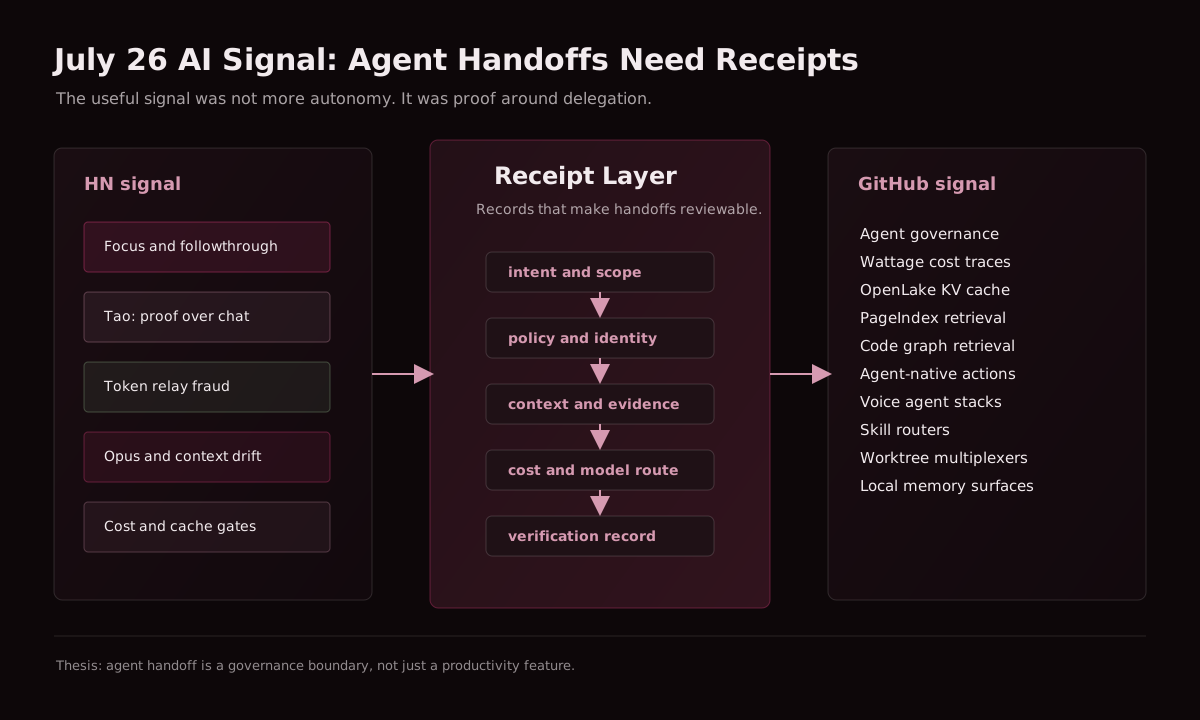
My read: the day's useful signal was not "agents can do more." It was that handoffs need records: scope, identity, evidence, policy, model route, cost, and verification.
Focus Is a Process, Not a Prompt
The essay The New AI Superpowers: Focus and Followthrough gave the human workflow frame.
That framing matters because it points away from the usual leaderboard argument. The practical advantage of AI is not just that a model knows more syntax or can write faster. The advantage appears when a human can keep a problem in motion for longer: outline, test, revise, compare, recover, and finish.
But focus and followthrough are not properties of a chat box. They are properties of a workflow.
intent
  -> plan
  -> evidence
  -> action
  -> interruption
  -> recovery
  -> verification
  -> final artifact
If the agent can move through that chain, the system has to preserve enough state to resume it. Otherwise the user is not delegating work. The user is repeatedly re-explaining work to a stateless assistant.
This also made Dan Luu's agentic test processes, LLM benchmarks, and other notes on agentic coding feel unusually relevant. The useful question is not "did the model pass a benchmark?" It is "what process produces reliable software when model behavior is variable?" Benchmarks are signals. Tests, review, traces, and rollback are receipts.
The practical product rule is simple:
| Handoff question | Required receipt |
|---|---|
| What did I ask the agent to do? | Intent, scope, and out-of-scope notes. |
| What did it inspect? | Source list, code paths, screenshots, logs, and retrieval records. |
| What changed? | Diff, action log, tool calls, and generated artifacts. |
| Why was this allowed? | Policy decision, identity, permission, and approval state. |
| How was it checked? | Tests, evals, benchmarks, or human review comments. |
| What happens next time? | Memory, known caveats, and replayable context. |
That is the receipt layer.
Proof Is the Cleanest Version of the Problem
Terence Tao's Mathematics in the Age of AI slides were another high-signal HN item.
Mathematics is useful here because it is one of the domains where the difference between fluent output and accepted work is brutally clear. A model can propose, search, compress, and connect. It can be a powerful exploration partner. But the final artifact still has to survive proof.
That is the clean version of the agent problem.
Most domains do not have such a sharp final validator. A coding agent has tests, but tests are incomplete. A research agent has sources, but source selection can be biased. A browser agent has screenshots, but screenshots do not prove business state. A finance agent has backtests, but backtests can lie.
So the rest of the stack has to approximate what mathematics gets from proof:
claim
  -> evidence
  -> independent check
  -> reproducible path
  -> accepted result
This is why I like projects that make verification boring: code review harnesses, test routers, static analyzers, cost gates, context retrievers, and skill versioning. They are not glamorous. They are how a handoff turns into work that another person can inspect.
The proof automation note was not an AI-agent story in the narrow sense, but it belongs in the same mental bucket. As more code and specs are generated with model help, proof and verification tooling become more valuable. The correct response to cheaper generation is not cheaper review. It is better evidence.
Token Fraud Is a Supply-Chain Warning
The HN post The relay market powering token resellers and fraud was the day's sharpest economic warning.
The agent market talks about tokens as cost. That is too narrow. Tokens are also a supply-chain object:
- they are bought through accounts
- resold through gray markets
- hidden behind relays and proxies
- mixed across providers
- attached to rate limits and abuse systems
- affected by provider policy and fraud detection
Agent products can quietly encourage bad architecture. If a workflow depends on "unlimited" subscriptions, borrowed accounts, stacked free tiers, or proxies that hide where traffic goes, then the cost layer is also a trust layer.
That is why I would be careful with projects that pitch free-tier aggregation as the main value. They can be useful for personal experimentation, but the product boundary is risky. If the route decides which provider sees private code, customer data, or logged-in browser state, then routing is not only cost optimization. It is governance.
The healthier projects in this group take a more measurable approach:
| Cost pressure | Better receipt |
|---|---|
| Expensive repeated prompts | Cache hit records and stable-prefix detection. |
| Long-horizon context | KV cache, context storage, and replayable retrieval. |
| Multi-model routing | Held-out task matrix and policy record. |
| Tool-call sprawl | Trace-level token accounting by action. |
| Free-tier routing | Explicit provider exposure and terms review. |
This is where Wattage, OpenLake, World Model Optimizer, and the AI tokenomics material fit. They are different answers to the same question: can we prove where the spend went and whether it bought useful work?
Context Is Now a Liability Surface
Several HN items circled around context:
- Elevated Errors for Opus 5
- Claude Code Deletes Your Context History from Your Device After 30 Days
- You can view a lot of Claude shared conversations via Google
- Claude Code has a hardcoded instruction telling Opus 5 not to use subagents
- Tokenflation: When "Hi" triggers 33 tool calls
These are not the same issue, but they rhyme.
Context is no longer just "what goes into the prompt." It is the working memory of the product. It includes local logs, cloud logs, shared conversation URLs, hidden system instructions, tool-call traces, cache behavior, and the model's ability to recover from a failed step.
That creates an awkward product truth:
The context that makes agents useful
is often the same context that makes them risky.
If context is retained too aggressively, it becomes a privacy and compliance problem. If it is deleted too quickly, long-running work becomes brittle. If shared conversations are indexable, a collaboration feature becomes an exposure path. If tool calls fan out on a trivial prompt, the product has no budget discipline. If hidden instructions route behavior, the user may not understand why an agent avoided or chose a path.
The receipt layer should answer:
| Context question | Why it matters |
|---|---|
| What context was stored locally? | Determines recoverability and local privacy. |
| What context was sent to a provider? | Determines data exposure. |
| What context was shared publicly? | Determines accidental disclosure risk. |
| What was compressed or omitted? | Determines whether evidence survived. |
| What hidden instruction shaped behavior? | Determines whether a user can explain the result. |
| What tool call expanded the budget? | Determines whether cost matched intent. |
Context engineering is not only prompt craft. It is product governance.
Repository Triage
The repository list was noisy. A lot of it was either a repeat from earlier field notes or not really an AI/ML/agent signal.
I did not re-review ego-lite, Buzz, open-code-review, Claude Cookbooks, BrowserOS, Instatic, OpenHuman, and Kronos in depth because they were already covered in recent field notes. Their continued presence still matters: browser state, agent workspaces, review harnesses, vendor recipes, local memory, and domain models are still hot.
The new or newly useful projects were the ones that added receipts around the handoff.
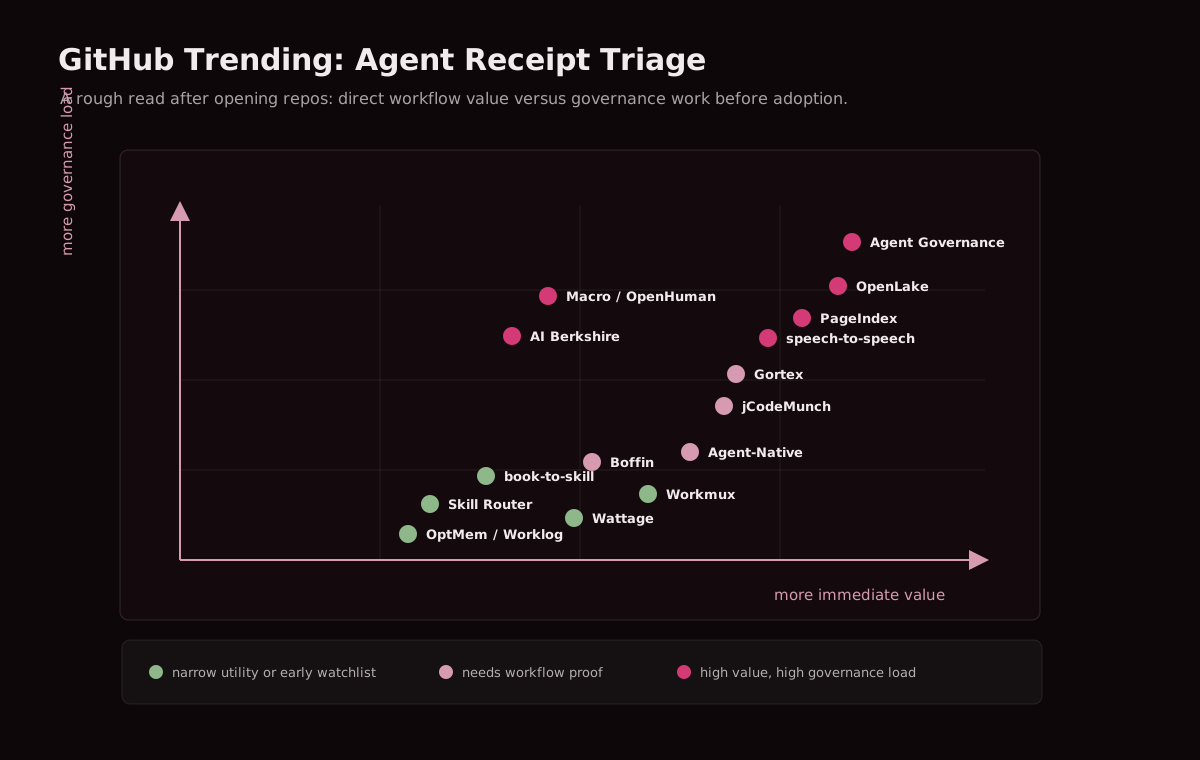
My rough triage after opening repos. High value does not mean "install immediately." It means the project points at a real bottleneck in agent work.
| Repo | My read | Why it has value | Main caveat |
|---|---|---|---|
| Microsoft Agent Governance Toolkit | Highest-signal governance repo | Policy enforcement, identity, sandboxing, audit records, packages, docs, and explicit OWASP framing. It names the right production questions: is this action allowed, who did it, and can you prove it? | Public preview. Governance frameworks can become theater if teams do not wire them to real tool boundaries and incident workflows. |
| Wattage | Tiny but sharp | Token-spend profiler for agent traces, with offline OTLP input, detectors, pricing, HTML reports, and CI failure mode. This is the right shape for cost receipts. | Very early and currently tiny. The value depends on real trace coverage and current pricing tables. |
| OpenLake | Serious infra direction | KV cache offload, context storage, vector serving, checkpointing, and GPU storage are real bottlenecks for long-context inference and agent memory. | Benchmark on your workloads. Storage layers become critical infrastructure quickly. |
| PageIndex | Useful retrieval challenge | Pushes against naive vector RAG by treating document retrieval as tree/index reasoning over pages. Good fit for long professional documents where similarity is not relevance. | The claims need task-specific comparison against strong vector, hybrid, and reranking baselines. |
| jCodeMunch MCP | Strong code-retrieval pressure signal | Agents should retrieve symbols and code slices, not entire files. The tree-sitter/MCP shape is right for reducing context waste. | The README has aggressive commercial language and large savings claims. Reproduce before relying on it. |
| Gortex | Practical code-intelligence substrate | Local code graph, MCP/CLI/API access, multi-repo support, many languages, and call-chain style retrieval are exactly what coding agents need. | Broad language support is hard. Check resolver quality on your language mix and review install-time agent config changes. |
| Agent-Native | Important app architecture | One action powering UI, agent, HTTP, MCP, A2A, and CLI is a clean product idea. It treats agent actions as first-class app surfaces. | Young framework and likely to shape your architecture. Try on a small internal app first. |
| speech-to-speech | Strong local voice stack | Modular VAD, STT, LLM, and TTS pipeline with an OpenAI Realtime-compatible WebSocket API. Local voice agents need this kind of swappable pipeline. | Voice data is sensitive. Consent, retention, latency, and failure handling matter more than demo smoothness. |
| book-to-skill | Useful knowledge packaging | Turning technical books or document folders into agent skills is a natural way to make reference material operational. | Copyright, hallucinated summaries, stale excerpts, and eval quality are the hard parts. |
| Impeccable | High-signal design harness | Design skills plus deterministic detectors are a concrete answer to AI UI slop. It is a receipt layer for taste and visual review. | Great for frontend quality, not a substitute for product thinking or accessibility checks. |
| Workmux / Worktrunk / Wmux | Practical work surfaces | Worktrees, tmux windows, and agent workspace multiplexing are boring but valuable when parallel agents become normal. | Parallel work multiplies review load. The tool is useful only if merge discipline and ownership stay clear. |
| Macro / OpenHuman / Meetily | Local memory direction | Local memory, meetings, workflows, voice, and personal context are real product surfaces. The value is obvious when the data stays near the user. | Personal-data systems have extreme privacy weight. Local-first does not remove consent, deletion, and audit requirements. |
| AI Berkshire / Kronos | Domain-agent signal | Finance is a useful stress test because agent output has high consequence and must be adversarially reviewed. | Treat as research or workflow scaffolding, not investment advice. Backtests and model narratives are easy to overtrust. |
| World Model Optimizer | Worth watching | Optimizing routing and distillation from agent traces is the right category if you already collect good traces. | Small and early. Bad traces or weak evals will optimize the wrong thing. |
| Boffin | Interesting constraint router | Routes edit-specific architectural constraints and requires verification, rather than dumping one giant repo rule file into context. | Early. The case-study style is promising but needs broader real-world proof. |
| SafeAI | Early security scanner | Static analysis for AI capabilities, prompts, tools, MCP exposure, and governance gaps is a necessary category. | Very young. Static analysis can find surfaces, not prove runtime safety. |
| Skill Router / Worklog / OptMem | Small but aligned | These attack bounded skill loading, structured local work state, and append-only memory. Each is narrow, but the direction is good. | Tiny adoption. Use ideas before depending on the repos. |
The valuable projects are not all the same maturity level. That is the point. The category is forming.
Governance Should Sit at the Action Boundary
Microsoft's Agent Governance Toolkit stood out because it does not start from "better prompts." It starts from action.
An agent that can call tools needs answers before the call executes:
agent wants action
  -> identify agent and task
  -> check policy
  -> check data sensitivity
  -> check tool authority
  -> allow, deny, redact, or escalate
  -> record the decision
That is a control surface.
Prompt safety is still useful, but it is not a boundary. A boundary has to survive prompt injection, malformed tool output, hidden instructions, confused identity, and partial failures. This is why governance belongs near tools, credentials, browsers, APIs, databases, and file systems.
SafeAI points at the same category from the static-analysis side. It tries to find AI capabilities, prompt risks, tool permissions, MCP integrations, and missing governance before deployment. That will not catch everything, but it is the right kind of early warning. An agent system should be able to answer "what powers did we accidentally expose?"
The better pattern is layered:
| Layer | What it catches |
|---|---|
| Static scan | Exposed tools, risky prompts, missing auth, MCP surfaces. |
| Policy check | Whether this agent may perform this action now. |
| Identity | Which agent, model, user, and workflow acted. |
| Sandbox | What the action can touch. |
| Trace | What happened. |
| Review | Whether the artifact should be promoted. |
No single layer is enough. The receipt is the combination.
Retrieval Is a Form of Evidence Control
PageIndex, jCodeMunch, and Gortex were the strongest context/retrieval signals.
The common mistake in agent systems is pretending retrieval is a convenience feature. It is not. Retrieval decides what evidence enters the model's working set.
That means retrieval has product consequences:
| Retrieval behavior | Failure mode |
|---|---|
| Read whole files | Wastes context and invites irrelevant reasoning. |
| Vector similarity only | Misses relevant material that is not textually similar. |
| Symbol lookup only | Misses cross-file behavior and runtime state. |
| Aggressive compression | Deletes the one detail that mattered. |
| No provenance | Makes the final answer impossible to audit. |
PageIndex is interesting because it argues that long-document retrieval should be relevance and reasoning aware, not only vector similarity. jCodeMunch and Gortex are interesting because code agents should ask for symbols, call paths, routes, and cross-repo contracts rather than blindly opening files.
My caveat is the same for all retrieval projects: token savings are not the final metric. The final metric is task success with preserved evidence.
I would measure:
- Did the agent find the right code faster?
- Did it miss fewer call paths?
- Did it preserve citations to the retrieved evidence?
- Did it reduce total retries, not only input tokens?
- Did it make review easier?
That last question matters. Retrieval is not only for the model. It is for the human reviewer who needs to know why the agent believed a change was safe.
Cost Needs to Move from Dashboard to Gate
Wattage is small, but I like the shape.
Most teams treat AI cost as a monthly dashboard. That is too late for agents. If a code change causes an agent loop to resend a stable prompt prefix, explode tool calls, miss cache hits, or escalate every small task to a frontier model, the cost regression should be caught like a performance regression.
The right workflow is:
trace
  -> price
  -> detect waste pattern
  -> show flame graph
  -> fail CI or require review
OpenLake attacks a lower layer of the same problem. Long-horizon inference and repeated prompts create pressure for KV cache offload, context storage, vector serving, and checkpointing. World Model Optimizer attacks the route/model side: use traces to compare models, fit routing policy, and distill small models.
These are all cost receipts.
The danger is optimizing the wrong metric. A cheaper route that fails silently is worse than an expensive route. A cache that leaks or corrupts context is worse than no cache. A trace optimizer trained on weak tasks will make the wrong behavior cheaper.
Good cost gates need quality gates beside them:
| Cost control | Required quality check |
|---|---|
| Cache | Token parity, privacy boundary, and invalidation rules. |
| Router | Held-out task success and escalation tests. |
| Compression | Evidence-retention checks. |
| Distillation | Drift and false-confidence measurement. |
| CI budget gate | Human override with reason recorded. |
Budget is part of autonomy. If a task can fan out across worktrees and models, spend becomes a permission.
Skills Are Becoming a Distribution Format for Work
book-to-skill, Skill Router, Impeccable, Boffin, OptMem, and Worklog all touch the same underlying shift: natural-language instructions are becoming operational artifacts.
A skill can tell an agent how to:
- read a codebase
- follow design taste
- use a tool
- route subagents
- consult a book
- remember a project
- verify a change
That means a skill is not "just text." It is behavior.
book-to-skill is useful because reference material often lives outside the agent's working memory. Turning a technical book or document folder into a skill can make that knowledge callable. Skill Router is useful because loading every skill into context is wasteful; skill libraries need discovery and bounded loading. Impeccable is useful because frontend agents need taste constraints plus deterministic checks. Boffin is useful because one repo-wide instruction block is a blunt instrument; edit-specific constraints are more plausible.
The hard part is governance:
| Skill issue | Receipt needed |
|---|---|
| Source material | License, version, excerpt boundaries. |
| Generated instruction | Changelog, review, and owner. |
| Skill selection | Why this skill was loaded. |
| Behavior change | Eval before/after. |
| Memory updates | Append-only log or reversible summary. |
| Design constraints | Detector output and visual review. |
Skills will become package managers for agent behavior. That is useful only if teams stop treating them like harmless snippets.
Voice and Personal Context Raise the Stakes
Hugging Face's speech-to-speech repo and Meetily are both local-first signals.
Voice agents are a natural next surface because conversation is faster than typing and because meetings are full of expensive context. But voice also raises the blast radius:
- consent
- speaker identity
- retention
- summarization errors
- sensitive background speech
- synthetic voice output
- local versus hosted processing
The speech-to-speech repo has the right engineering shape: VAD, STT, LLM, and TTS as swappable components, exposed through an OpenAI Realtime-compatible API. That makes local and hosted routes interchangeable. Meetily points at the product demand: local transcription, diarization, and summarization for meetings.
But voice receipts have to be stronger than chat receipts.
For a voice agent, I want records of:
- when recording started and stopped
- who consented
- where audio was processed
- whether raw audio was retained
- which transcript segments were uncertain
- which summary claims map to which transcript spans
- whether synthetic voice output was generated
Local-first is a good default. It is not a governance model by itself.
Domain Agents Need More Than Confidence
AI Berkshire and Kronos are useful market signals because finance attracts agents early. It also punishes sloppy validation.
A multi-agent investment research framework can be useful if it structures:
- thesis generation
- adversarial review
- source collection
- valuation assumptions
- portfolio constraints
- uncertainty
- decision logs
But if it turns famous-investor methods into fluent narratives without hard evidence, it is dangerous. Finance is full of stories that sound smart after the fact.
The same caution applies to any domain agent:
| Domain | Required receipt |
|---|---|
| Finance | Assumptions, data sources, backtests, risk limits, no implicit trade authority. |
| Healthcare | Source provenance, uncertainty, clinician review, privacy controls. |
| Legal | Jurisdiction, citations, versioned law, attorney review. |
| Education | Learning outcome evidence, not only generated content. |
| Security | Scope, authorization, sandbox, exploit trace, disclosure path. |
Domain agents are valuable when they encode domain gates. They are risky when they only encode domain vocabulary.
Validation Harness
A handoff bench should force each workflow to emit receipts before the user trusts the result:
wattage price traces/agent-run.otlp --fail-over-usd 1.50 --out out/cost-report.html
gortex query "checkout retry path" --repo . --json > out/code-evidence.json
agent-policy eval policies/high-authority.yaml fixtures/tool-calls.jsonl --out out/policy.json
workmux run fixtures/parallel-agents.yaml --branches 3 --out out/worktrees.json
skillctl release skills/book-notes.md --changelog CHANGELOG.md --eval fixtures/skill-evals.yaml
voice-receipts audit transcripts/meeting.vtt --audio-local --out out/meeting-receipts.json
The report should connect cost, context, policy, branch ownership, skill version, and media consent:
{
  "cost": {"usd": 0.84, "cache_misses": 3, "tool_call_tokens": 18420},
  "retrieval": {"missed_expected_paths": 0, "evidence_ids": ["code:checkout/retry.ts:42"]},
  "policy": {"denied": 1, "escalated": 2},
  "worktrees": [{"branch": "agent/attempt-a", "owner": "agent-runtime-7"}],
  "skill": {"version": "book-notes.md@4f2c", "eval_pass": true},
  "voice": {"consent_recorded": true, "raw_audio_retained": false}
}
The point is delegation with recoverable trust.
Handoff Receipt Contract
The human-side material covered focus, followthrough, mathematical proof, token fraud, outages, context retention, shared conversation leakage, tool-call inflation, containment notes, and agent testing. The tool-side material covered governance frameworks, static risk scanners, cost profilers, KV cache stores, retrieval engines, agent-native action layers, skill routers, worktree multiplexers, local memory, and voice-agent stacks.
Those are not separate stories.
They are all about what has to survive after a person gives work to an agent.
The chat box is the wrong system of record. A serious agent product needs receipts:
- intent receipts
- evidence receipts
- policy receipts
- identity receipts
- context receipts
- cost receipts
- retrieval receipts
- skill receipts
- verification receipts
The best products will make the phrase "do this for me" auditable.
They will make it possible to answer, later and under pressure:
What happened?
Who or what did it?
What evidence was used?
Which boundary allowed it?
What did it cost?
How was it checked?
Why should we trust the result?
Agent infrastructure should make handoffs inspectable.
Sources
- Rick Manelius: The New AI Superpowers: Focus and Followthrough
- Terence Tao: Mathematics in the Age of AI PDF
- Vectoral: The relay market powering token resellers and fraud
- Claude Status: Elevated Errors for Opus 5
- Dan Luu: Agentic test processes, LLM benchmarks, and other notes on agentic coding
- Claude Code docs: Data usage
- Anthropic: How Anthropic secures its AI-native software development lifecycle
- Quesma: Tokenflation
- GitHub: OpenLake
- GitHub: Wattage
- GitHub: World Model Optimizer
- GitHub: HART OS
- GitHub: Boffin
- GitHub: Torafirma Skill Router
- GitHub: Awesome AI Tokenomics
- GitHub: Wmux
- GitHub: Worklog
- GitHub: OptMem
- GitHub: Microsoft Agent Governance Toolkit
- GitHub: PageIndex
- GitHub: jCodeMunch MCP
- GitHub: Gortex
- GitHub: Agent-Native
- GitHub: speech-to-speech
- GitHub: book-to-skill
- GitHub: Impeccable
- GitHub: Workmux
- GitHub: Worktrunk
- GitHub: Macro
- GitHub: AI Berkshire
- GitHub: DataFlow
- GitHub: Meetily
- GitHub: SafeAI
- GitHub: aisuite
- GitHub: Chat2DB