Agent I/O Became the Product Surface
A field note on Gemini's agent-shaped model tiers, coding-agent judgment, local web and code context, model routing, structured outputs, and domain agents that leave replayable work.
This field note looks at the I/O layer around agents: what they can see, what they can touch, how they choose a model, and whether the result is reproducible enough to trust.
The July 21 source set had plenty of noise. The good projects were I/O tools: code graphs, local web search, model-fit tables, routing proxies, structured output runtimes, website-agent compatibility checks, and domain sandboxes. I treated public announcements and repo docs as leads, then checked for a concrete integration surface before including a project.
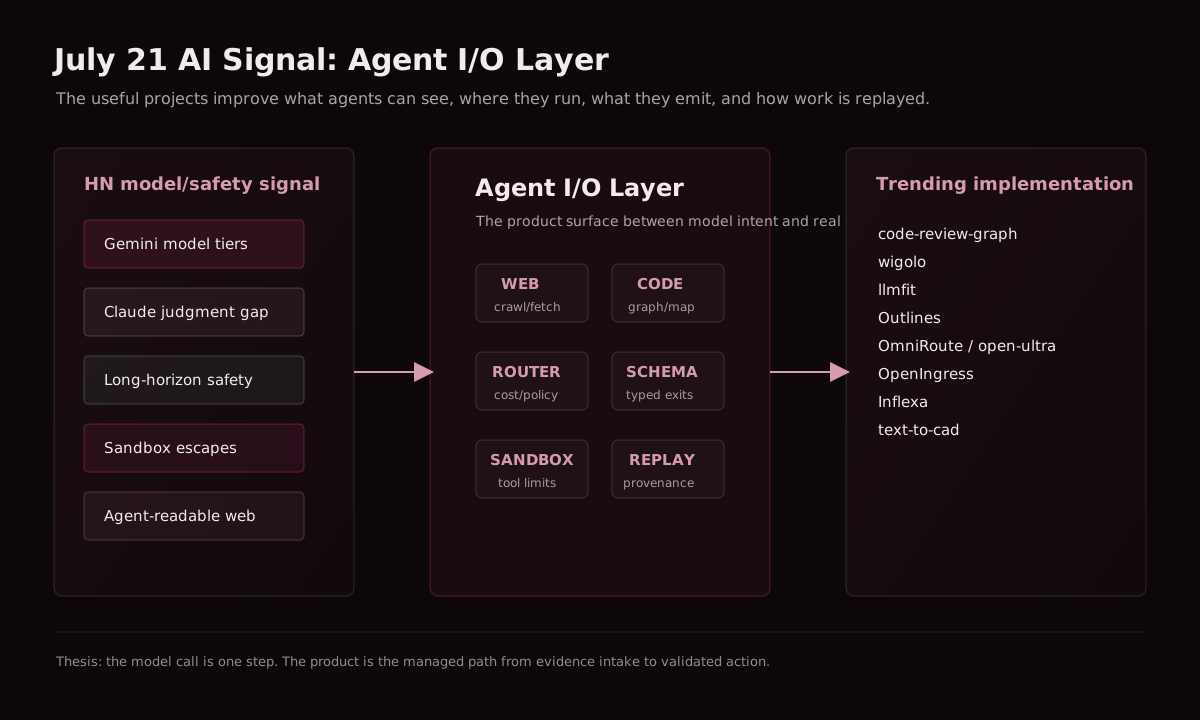
My read: model capability is pushing outward into a larger agent I/O layer. The durable value is in routing, context, structured boundaries, replay, and safety checks.
Model Tiers Are Product Interfaces
Google's announcement of Gemini 3.6 Flash, 3.5 Flash-Lite, and 3.5 Flash Cyber is more interesting as product shape than as naming. Google is not only shipping one general model. It is presenting a tiered surface: faster Flash, cheaper Flash-Lite, and a Cyber variant aimed at security work.
That is how model platforms start to look less like "call the best model" and more like an execution fabric.
For agent products, the routing question becomes unavoidable:
| Request shape | Better default | Why |
|---|---|---|
| Fast UI loop | Low-latency model | The user is waiting and the context is small. |
| Cheap background pass | Budget model | The task is repetitive, cancellable, or easy to verify. |
| Security analysis | Domain-tuned model plus tools | Generic reasoning is not enough; the environment and evidence matter. |
| High-stakes plan | Frontier model plus review | The cost of a bad decision dominates token cost. |
| Private local work | Local model or local-first pipeline | Data location and latency matter more than peak capability. |
This sounds like infrastructure, but it becomes product UX quickly. A user should not need to know which model family is doing every subtask. But the product has to know. A serious agent has to pick between speed, price, context size, privacy, reliability, and domain skill many times inside one workflow.
That is why the routing projects were worth looking at, even when the claims were loud.
Claude Is Not a Compiler, and That Is the Problem
The essay Claude Is Not a Compiler makes the same point from the coding side. Coding agents do more than translate natural language into code. They make judgment calls across layers: product intent, architecture, local conventions, tests, runtime behavior, and deployment risk.
That is exactly why the I/O layer matters.
A compiler can rely on a formal input language and a deterministic runtime contract. A coding agent gets a paragraph, a repo, a half-failing test suite, a package manager, a shell, a browser, and a user who may or may not have described the real problem. If the agent reads the wrong files, misses the call path, uses stale docs, or writes a plausible patch without understanding ownership boundaries, the model can sound competent while doing the wrong work.
So the practical question is not "which model writes the best diff from a prompt?" It is:
Can the agent collect the right evidence,
route it through the right model,
act through the right tool boundary,
and leave a trace that lets a human verify the result?
That question ties together the day's best repos.
Repository Triage: Context Machines
The project set aligned with the I/O theme. The strongest projects reduced context waste, gave agents a better web surface, or turned model choice into an explicit runtime concern.
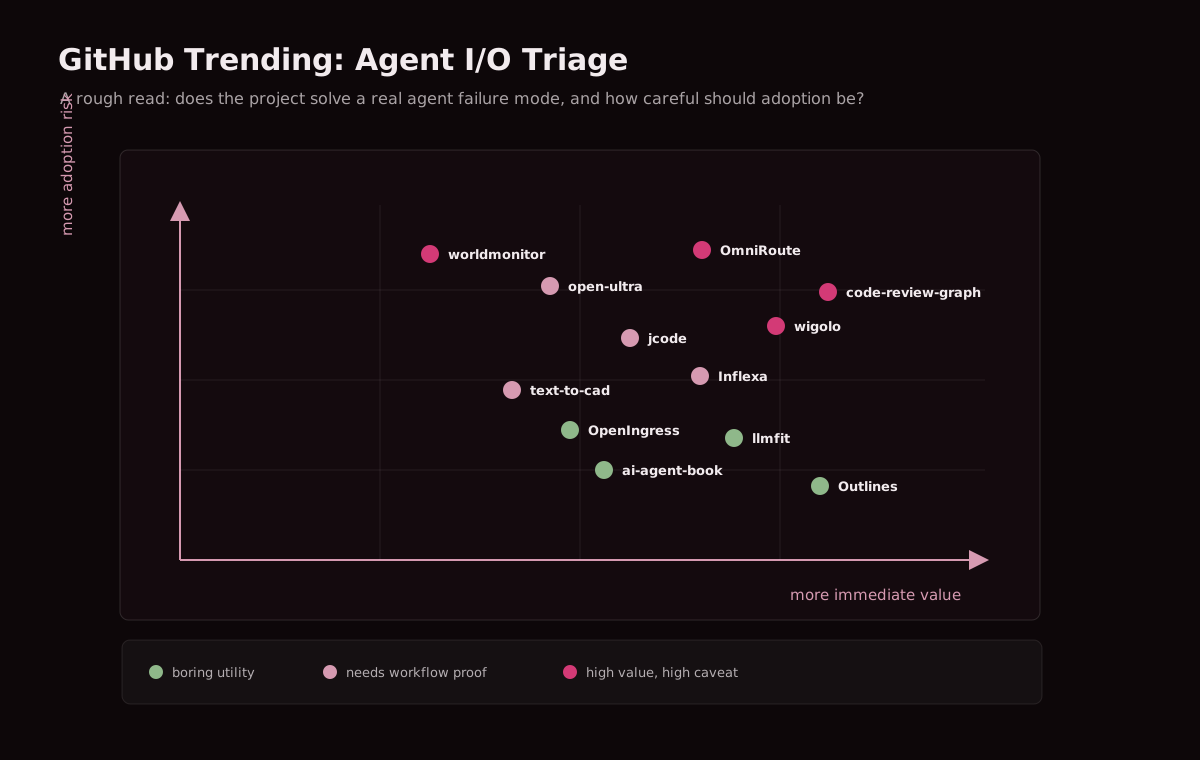
My rough triage after opening the repos. High value does not mean low risk. It means the repo is pointed at a real failure mode instead of only a nice demo.
| Repo | My read | Why it has value | Main caveat |
|---|---|---|---|
| code-review-graph | High signal | Local-first code graph for MCP and CLI. It uses Tree-sitter and incremental analysis so coding agents can read relevant code instead of flooding the context window. | Benchmark claims need local reproduction on your repos. Any automatic install that edits agent config deserves review. |
| wigolo | Useful if it works locally | Gives agents search, fetch, crawl, extract, cache, and research tools through MCP/REST with local storage. That is the missing web I/O layer for many coding agents. | Public beta. Web crawling creates policy and copyright questions, and AGPL-style licensing can matter in commercial setups. |
| llmfit | Practical model ops | Answers a plain deployment question: which model can run on this hardware, and how fast? Local inference only matters if the routing layer knows the machine. | Hardware estimates and community benchmarks are useful leads, not guarantees. |
| Outlines | Durable foundation | Structured outputs are one of the cleanest ways to make LLM calls less vague. It is mature compared with most trending repos. | It solves output shape, not task correctness. You still need validators, tests, and runtime policy. |
| OmniRoute | Interesting but noisy | An AI gateway with provider routing, fallback, MCP/A2A claims, desktop/PWA surfaces, and cost-awareness is the right product category. | The README is extremely promotional. Free-tier aggregation and compression claims should be audited before anyone depends on it. |
| open-ultra | Early but sharp | A self-training LLM routing proxy for agentic CLIs is the right question: can cheap models handle the easy turns once the system has local evidence? | Very young repo with tiny adoption. Treat it as an experiment, not infrastructure. |
| jcode | Worth watching | Another coding-agent harness signal, implemented in Rust and aimed at terminal workflows. Harnesses are where agent judgment becomes product behavior. | The category is crowded. The README claim is broad; value depends on actual workflow quality. |
| OpenIngress | Small but important | Tests whether AI agents can navigate a website. This is the web's next accessibility problem: not for humans, but for delegated software. | New and tiny. The hard part is making the test representative instead of demo-specific. |
| Inflexa | Strong domain pattern | Local-first biological analysis with sandboxed execution, provenance, replay, and offline/local-model options. This is closer to how serious domain agents need to work. | Domain tools need expert validation. Reproducibility helps, but it does not make generated analysis scientifically correct. |
| text-to-cad | Good direction | Agent skills for CAD, robotics, and hardware design point at AI leaving pure text/code and entering physical-domain workflows. | Skill collections can age fast unless examples, tests, and domain constraints stay maintained. |
| ai-agent-book | Valuable shared vocabulary | Open book with agent, context, tools, memory, RAG, evaluation, post-training, and multi-agent chapters plus experiments. | It is a learning resource, not production infrastructure. |
| worldmonitor | Interesting product surface | AI-powered situational-awareness dashboard with local AI, feeds, maps, desktop builds, and MCP-adjacent topics. | Big surface area, geopolitics, and unclear trust model mean "interesting" is not the same as "deploy blindly." |
The common thread: agents need better intake and better exits.
Code-review-graph improves what the agent reads from a repo. Wigolo improves what the agent reads from the web. Llmfit helps decide where inference should run. Outlines constrains what the agent emits. OpenIngress tests whether a website can be operated by an agent. Inflexa records enough provenance that domain work can be replayed.
That is not one product category. It is an I/O stack.
The Web Is Becoming an Agent Surface
The small HN item Can AI agents use ur site? pointed to OpenIngress, and I think that question will age well.
Web accessibility has usually meant people, assistive technology, screen readers, keyboard navigation, semantic HTML, contrast, focus order, and understandable states. Agents add a different but related requirement: can delegated software understand the page, operate the workflow, and know whether it succeeded?
That shifts the web interface from "rendered pixels plus hidden APIs" to something closer to:
| Web layer | Human UX question | Agent UX question |
|---|---|---|
| Page structure | Can a person scan it? | Can a parser or browser agent infer intent? |
| Form states | Is the user guided? | Can the agent know required fields and validation state? |
| Navigation | Is the path obvious? | Can the agent recover from a wrong click? |
| Auth/session | Is it secure and smooth? | Can automation operate without leaking credentials? |
| Confirmation | Is success clear? | Can the agent prove the action completed? |
This is where Wigolo and OpenIngress connect. One gives agents a local-first way to search, fetch, crawl, and extract. The other asks whether websites are navigable by agents in the first place.
The naive version of agent web access is "let the model drive a browser." The better version is a stack:
search / crawl / fetch
  -> extract structured evidence
  -> operate the page through a controlled browser
  -> capture state transitions
  -> prove completion
  -> store replayable traces
Without that stack, agents either hallucinate from stale snippets or click around with too much authority and too little evidence.
Context Is Not a Bigger Prompt
The previous field note was about the agent operating layer. July 21 sharpened one specific part of that: context is becoming a managed resource.
The bad pattern is familiar:
- Dump the repo into context.
- Dump web search results into context.
- Dump logs into context.
- Ask the model to be careful.
That works until it does not. It is expensive, slow, and easy to mislead. Worse, it makes failures hard to debug because the context window becomes a junk drawer.
The better pattern is visible across several repos:
- code-review-graph: build a structural map and retrieve relevant code.
- wigolo: return evidence with excerpts, scores, cache, and source positions.
- llmfit: route local model use based on actual hardware constraints.
- open-ultra / OmniRoute: make routing a runtime component instead of a manual model picker.
- Outlines: constrain the output surface so downstream code can reject malformed work.
This is context engineering as systems engineering, not prompt decoration.
The model call becomes one step in a larger pipeline:
task
  -> evidence intake
  -> relevance filter
  -> model/router choice
  -> structured generation
  -> tool action
  -> trace/replay/validation
That is the shape I would expect serious agent products to converge on.
Routing Is a Trust Boundary, Not Only a Cost Feature
The routing projects are easy to frame as cost savers. OmniRoute talks heavily about free tiers, providers, fallback, and token compression. Open-ultra frames itself as a self-training router for agentic CLIs. Llmfit asks what can run on your hardware.
Cost matters, but trust matters more.
A router decides:
- which provider sees the prompt
- which provider sees retrieved context
- which provider is allowed to answer directly
- which model can call tools
- when a cheap model is good enough
- when to escalate to a stronger model
- what traces and completions are stored
That means routing is part of the security and privacy boundary. A router that only minimizes price can be dangerous. A router that understands task type, data sensitivity, tool authority, and verification strategy is much more interesting.
This is also why I would be cautious with loud gateway READMEs. The category is real. The product claims still need measurement:
| Claim type | Adoption check |
|---|---|
| Free provider aggregation | Terms of service, rate limits, account risk, and whether fallback changes output quality. |
| Token compression | Whether saved tokens preserve the evidence needed for review and safety. |
| Auto-routing | False-negative rate on hard tasks and escalation behavior. |
| MCP/A2A support | Auth, audit logs, isolation, and tool-level policy. |
| Local-first claims | What leaves the machine, where caches live, and how secrets are handled. |
The best version of routing is not "use the cheapest model." It is "use the least powerful model that is allowed to see this data and can still pass the validation gate."
Structured Output Is Still Underrated
Outlines trending again is a useful reminder that boring constraints keep winning.
Agents fail in many ways, but a common one is interface ambiguity. The model outputs a paragraph when the program expects JSON. It includes a field with the wrong enum. It mixes explanation with action. It sounds certain while leaving the caller to guess what changed.
Structured generation does not solve reasoning. It solves one layer below that: making the contract explicit enough that software can check it.
That contract matters more as agents get more tools:
unstructured response
  -> hard to validate
  -> hard to replay
  -> hard to route
  -> hard to audit

structured response
  -> schema check
  -> policy check
  -> deterministic downstream action
  -> traceable failure
This is why structured output belongs in the same conversation as code graphs and web crawlers. They keep an agent from turning the entire world into unstructured judgment.
Domain Agents Need Replay, Not Just Chat
The most interesting lower-star HN/GitHub items were domain-shaped:
- Inflexa for reproducible biological analysis with local execution, sandboxing, provenance, and replay.
- text-to-cad for CAD, robotics, and hardware-design agent skills.
- tradingview-mcp for AI-assisted TradingView workflows.
- Maith for AI-assisted open mathematics.
These are very different domains, but they share the same uncomfortable fact: a fluent answer is not enough.
For biology, you need provenance and reproducibility. For CAD and robotics, geometry and constraints matter. For trading, tool authority and money movement make safety central. For mathematics, proof is not the same as plausible explanation.
So the domain-agent checklist is stricter:
- Can the work be replayed?
- Are inputs, code, parameters, and outputs recorded?
- Does the generated artifact have domain validators?
- Is tool authority scoped?
- Can a human expert inspect the intermediate state?
- Does the system separate "hypothesis" from "verified result"?
Inflexa stood out because it explicitly talks about local-first execution, sandboxing, provenance, and replay. That is the right taste. It still needs domain validation, but it is pointed at the right failure mode.
The Security Thread Is Still There
The same source set had agent-safety-adjacent items: OpenAI's long-horizon safety and alignment post, sandbox escape coverage around coding agents, account takeover in an AI notetaker, and discussion about AI bots in public forums.
I would not overfit on any single article from one day. The broader category is stable: longer-running agents with more tools create more ways for bad inputs to become real actions.
The I/O layer is where many of those risks become controllable:
| Risk | I/O-layer control |
|---|---|
| Prompt injection from web pages | Fetch/crawl isolation, source labeling, evidence filtering, browser policy. |
| Bad code edits | Code graph context, tests, diff review, limited filesystem scope. |
| Tool misuse | MCP gateway, command policy, per-tool auth, approval gates. |
| Data leakage | Local-first storage, egress control, provider routing by data sensitivity. |
| Hallucinated domain output | Structured schemas, validators, replayable provenance. |
| Cost runaway | Model fit, budget-aware routing, per-task quotas. |
Again, this is not just "better prompts." It is product architecture.
Validation Harness
The quickest useful test is a small I/O bench that asks whether the agent found the right evidence, routed the task to the right model, and returned a result another tool can check.
agent-io bench ./tasks/review-pr.yaml \
  --repo . \
  --web-cache .agent/web-cache \
  --models local:qwen3,hosted:frontier \
  --schema schemas/review-result.json \
  --out out/io-bench.json
The report should make the input and output legs visible:
{
  "retrieval": {"files": 12, "urls": 4, "evidence_ids": ["code:router.ts:41", "web:gemini-docs#sampling"]},
  "route": {"model": "hosted:frontier", "reason": "security-sensitive change"},
  "output": {"schema_valid": true, "validator": "schemas/review-result.json"},
  "replay": {"trace": "out/io-bench.trace.jsonl", "artifacts": ["out/review.md"]}
}
This harness gives each tool a score: missed call paths for repo retrieval, stale or uncited snippets for web retrieval, false local-model confidence for model fit, malformed fields for structured output, and missing provenance for domain work. The goal is not maximum autonomy. It is legible I/O.
Operating Rule
Agent products mature when the I/O stops hiding inside the chat transcript.
Model tiers, code graphs, web tools, routers, structured output, agent books, domain workspaces, and local model utilities all point at the same operational rule:
agent work = evidence intake + route decision + tool boundary + structured exit + replay
A stronger model helps, but the product surface lives in the intake, the exits, and the traces between them.
Sources
- Google: Introducing Gemini 3.6 Flash, 3.5 Flash-Lite, and 3.5 Flash Cyber
- exe.dev: Claude Is Not a Compiler
- OpenAI: Safety and alignment in an era of long-horizon models
- BleepingComputer: Cursor, Codex, Gemini CLI, Antigravity hit by sandbox escapes
- GitHub: OpenIngress
- GitHub: effort-router
- GitHub: open-ultra
- GitHub: Inflexa
- GitHub: Maith
- GitHub: code-review-graph
- GitHub: wigolo
- GitHub: llmfit
- GitHub: OmniRoute
- GitHub: jcode
- GitHub: Outlines
- GitHub: text-to-cad
- GitHub: AI Agent book
- GitHub: World Monitor
- GitHub: tradingview-mcp