The Kernel Around Local Agents
A field note on small local models, Claude memory leakage, DSL-shaped reliability, and the agent infrastructure that outlasts demo hype.
This field note starts from a specific infrastructure question: what does an agent need around the model before it can act through tools with user trust?
The July 15 source set did not center on one frontier-model launch. The stronger pattern was an operating layer: small local models, permission hooks, context routers, browser surfaces, gateways, DSLs, and managed-agent boards turning into system calls.
I treated public articles and repo docs as leads, then checked each project for an install path, trust boundary, maintainer signal, and evidence surface. This is not a popularity recap. It is a field note on what looks durable.
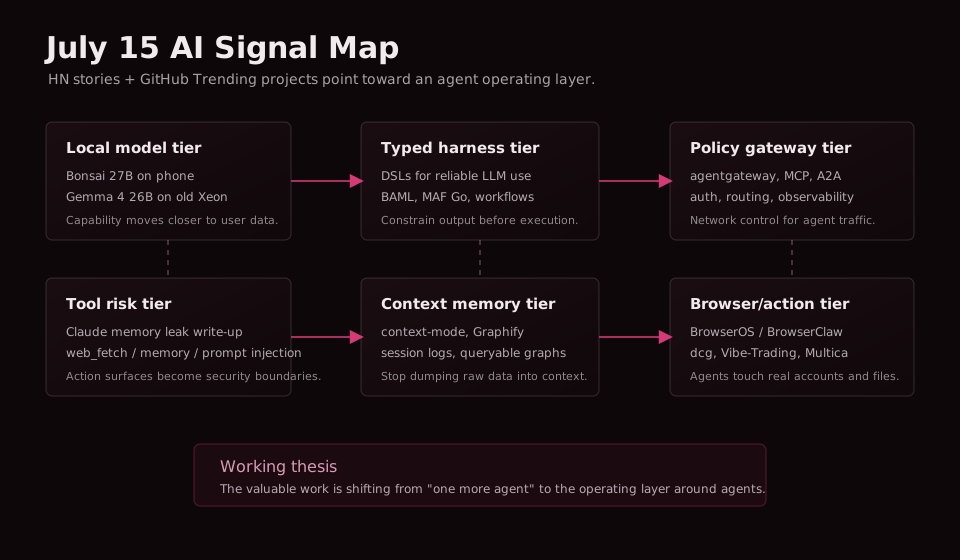
The pattern I saw: model compression pushes capability closer to the user; agent systems then need permissions, context discipline, browser state, gateways, and workflow control planes.
Local Capability Is Getting Weird
Bonsai 27B is a 27B-class multimodal model marketed as runnable on a phone through 1-bit and ternary weight compression. Whether the benchmark story holds up under independent testing is a separate question, but the direction matters: the "local model" threshold is no longer only about a 7B chat model on a laptop. It is about models large enough to support reasoning, tool calls, and visual input while fitting into consumer-device memory budgets.
That paired well with a second public benchmark note: running Gemma 4 26B at about 5 tokens/sec on a 13-year-old Xeon with no GPU. The number is not production-fast. The important part is psychological. Once a serious model can run on old commodity hardware, the default product assumption changes from "the cloud model is the product" to "the cloud model is one tier in a local/cloud execution stack."
This does not mean frontier API models stop mattering. It means the product surface gets more layered:
| Layer | What local models unlock | What they do not solve |
|---|---|---|
| Phone / laptop | Private drafting, offline assistance, cheap background tasks, low-latency UI loops. | Deep tool work, long context, best reasoning, enterprise policy, shared memory. |
| Old CPU boxes | Batch transforms, local indexing, private document work, background agents. | Smooth UX, high throughput, multimodal workloads at scale. |
| Cloud model | Hard reasoning, coordination, large-context work, model diversity. | Trust boundaries, tool safety, local credentials, auditability. |
The practical read is boring but important: hybrid inference is becoming normal. A serious agent product should expect to route across local, cheap, and frontier models instead of pretending one model tier owns every job.
Tool Access Is the Security Story
The Memory Heist gave the security shape: Claude data exfiltration through tool use and memory leakage. The exact exploit will age. The category will not.
When an assistant can fetch URLs, remember user details, call tools, and decide how to combine all of that, the trust boundary is no longer "did the model say a bad thing?" The boundary is "what action surface did we give a probabilistic planner?"
That makes a few repository projects feel much less like side utilities and much more like infrastructure:
- destructive_command_guard blocks dangerous shell, git, database, Kubernetes, cloud, and filesystem commands before agent hooks execute them.
- context-mode tries to keep raw tool output out of the model context while preserving session continuity.
- agentgateway puts MCP, A2A, LLM routing, policy, auth, and observability behind an agent-aware proxy.
- BrowserOS / BrowserClaw moves web automation into a local browser that can use real logged-in sessions, with live watching and replay.
The common idea is simple: agent tools need their own control surface.
Prompt engineering is not enough. A model that is allowed to call web_fetch, read memory, run shell commands, drive a browser, or place trades needs policy at the tool boundary. This is the same lesson as every other platform shift: once software can act, the boring enforcement layer becomes the product.
DSLs, Harnesses, and the End of "Just Ask the Model"
Martin Fowler's DSLs Enable Reliable Use of LLMs supplied the typed-interface signal. The argument is not that DSLs are fashionable again. It is that LLMs become more reliable when the output space is constrained by domain abstractions, validators, and a runtime that can reject invalid work.
That connects to three other threads from the day:
- Towards a harness that can do anything points at the harness as the part that turns model output into useful action.
- BAML keeps showing up because typed agent IO is one of the cleanest ways to remove ambiguity from model calls.
- Microsoft Agent Framework for Go entering public preview matters less because of star count and more because Go teams now get a first-party production-agent framework with workflows, middleware, observability, MCP, A2A, and checkpointing in their native language.
The reliable agent pattern is starting to look like this:
natural language request
  -> typed domain interface
  -> planner / workflow graph
  -> policy checked tool call
  -> observable runtime event
  -> durable session state
The interesting part is not that every step is new. It is that agent systems are finally admitting each step has to exist.
Repository Triage
The project list was noisy. Some repos were useful. Some were lists. Some were demos with a great README and unclear operational depth. Some were probably valuable but not yet something I would recommend to a team without a trial.
My filter was:
- Does this solve a real agent failure mode?
- Is there a runnable product or install path?
- Is the trust boundary clear?
- Does the repo look maintained?
- Is the license compatible with real adoption?
- Would I still care if the star graph cooled down tomorrow?
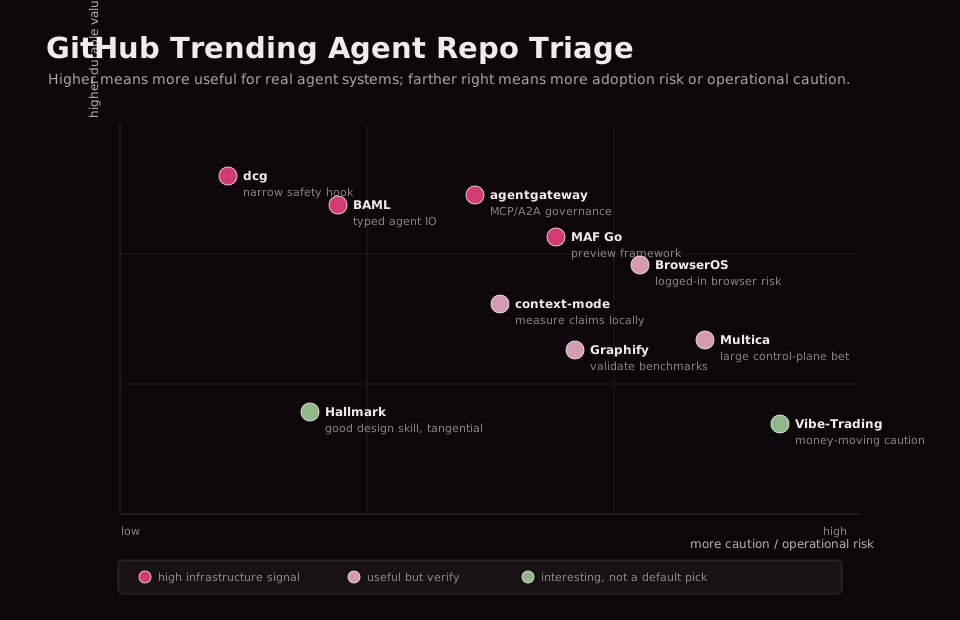
My rough read after opening the repos. High value does not mean low risk. Some of the best ideas here are exactly the ones that need careful deployment.
| Repo | My read | Why it has value | Main caveat |
|---|---|---|---|
| destructive_command_guard | Useful now | Hooks into coding agents and blocks destructive commands before execution. This is a real, narrow failure mode with immediate utility. | Custom license / policy design deserves review before team-wide rollout. Fail-open behavior is a product tradeoff. |
| context-mode | Worth testing | Treats context as a routed resource, not a dumping ground. The SQLite/FTS5 continuity idea is directionally right. | Some claims need local measurement. License/commercial boundary matters. |
| agentgateway | Serious infra | MCP + A2A + LLM routing + auth + observability is exactly where agent platforms are heading. | This is infrastructure, not a toy. Operational complexity is the price of governance. |
| BrowserOS / BrowserClaw | Important but sensitive | A local, auditable browser for agents addresses the "my agent cannot press buttons" problem without defaulting to a cloud browser. | Logged-in browser sessions are high-value assets. Local replay helps, but policy still matters. |
| Microsoft Agent Framework for Go | High signal for Go shops | First-party Go support for production agents and workflows makes agent orchestration less Python-only. | Public preview. Feature parity with .NET/Python is still evolving. |
| Multica | Interesting control plane | Treats coding agents as assignable teammates with boards, runtimes, skills, and recurring work. This is the right product category. | Strong product claim, unclear license metadata, and a lot of surface area to operate. |
| Graphify | Useful if validated | Code/doc knowledge graphs are a better fit for agent navigation than dumping files into context. Local code parsing is the right instinct. | Very fast star growth plus benchmark claims should be independently reproduced before adoption. |
| BAML | Durable concept | Typed agent interfaces and runtime validation are fundamental. | Best when the team is willing to introduce a new language/toolchain boundary. |
| Vibe-Trading | Watch carefully | It is active and tool-rich, and it has recent security-hardening notes. A trading agent is a real stress test for agent tooling. | Money-moving agents are the wrong place to confuse demo quality with safety. I would treat it as research until proven under hard constraints. |
| Hallmark | Tangential but good taste | Anti-slop design skills are useful because AI UI defaults are getting painfully samey. | More design workflow than agent infrastructure. Valuable, but not the center of this field note. |
The meta-point: the valuable projects are not "one more agent." They are pieces around agents: permission hooks, context routers, gateways, browsers, typed interfaces, workflow engines, and team control planes.
That is a healthier direction than another leaderboard demo.
The Agent OS Stack
Compressed into one architecture, the pattern looks like an operating layer for agents:
| OS-like layer | Agent version | Example signal |
|---|---|---|
| Process scheduler | Workflow graph, harness, managed-agent queue | Microsoft Agent Framework, Multica, "harness" discussions |
| Syscall boundary | Tool call broker, shell hook, browser driver | destructive_command_guard, BrowserClaw, MCP tools |
| Memory manager | Context router, session log, retrieval index | context-mode, Graphify, local model indexes |
| Network stack | Agent-aware gateway, MCP/A2A proxy, auth, egress policy | agentgateway |
| Device driver | Browser, file system, editor, terminal, database, trading API | BrowserOS, Vibe-Trading, Aict |
| Userland apps | Skills, DSLs, domain workflows | Hallmark, BAML, DSL-shaped LLM development |
This is why the "agent as teammate" metaphor can be misleading. A teammate does not need a kernel. An agent does, because it is not only thinking. It is making calls into systems with state, credentials, money, files, and people on the other side.
The product opportunity is not just to make agents smarter. It is to make the operating layer legible enough that teams can trust more autonomy.
Validation Harness
Before adopting any agent runtime, I would run a small harness that checks the four boundaries most likely to fail: command policy, context routing, gateway traceability, and browser replay.
agent-policy check --command "rm -rf dist" --cwd "$PWD"
agent-context ingest logs/test-run.txt --max-bytes 32768 --redact-secrets
agent-gateway probe --mcp http://localhost:3000/mcp --trace out/gateway.json
agent-browser run smoke.yaml --record out/browser.har --video out/browser.webm
The expected report is not a paragraph. It should name the command decision, the bytes admitted to context, the MCP method called, the credential scope, and the browser state captured:
{
  "command": {"decision": "deny", "rule": "destructive-file-delete"},
  "context": {"input_bytes": 91742, "admitted_bytes": 32768, "redactions": 3},
  "gateway": {"method": "tools/call", "trace_id": "gw_20260716_001"},
  "browser": {"space": "agent-smoke", "artifacts": ["out/browser.har", "out/browser.webm"]}
}
Only then do typed interfaces belong in the path. A minimal decision contract is enough to catch ambiguous automation:
type ToolDecision = {
  action: "allow" | "deny" | "escalate"
  reason: string
  evidenceIds: string[]
}
The adoption gate is simple: no agent gets broader tool access until the harness can produce these records without a human reconstructing the run from a chat transcript.
The Local Model Angle
The Bonsai and Gemma items matter because they make the operating layer more complicated, not less.
When a model runs locally, users will expect:
- private document transforms
- offline assistants
- lower latency UI
- cheap background work
- local indexing and codebase understanding
- fallback when cloud models are unavailable or too expensive
But local inference also creates routing questions:
- Which tasks stay local?
- Which tasks need a frontier model?
- Which model is allowed to see secrets?
- Which model is allowed to call tools?
- Which traces are stored locally vs uploaded?
- How do we audit a local agent that acted through a browser session?
In other words, local models do not remove the need for platform engineering. They increase the number of places where policy has to be clear.
The Hard Part Is Not "Agent"
The word "agent" is doing too much work. The useful projects here were mostly about the words around it:
- safe
- typed
- routed
- observable
- local
- replayable
- governed
- assignable
Those are infrastructure words. They are less exciting than "autonomous," but they are the words that make autonomy usable.
My read: the next serious wave of AI tooling will not be won only by better model wrappers. It will be won by the tools that make agent behavior inspectable before, during, and after action.
The strongest projects in the table understand that. They are building the routine layer between "the model wants to do something" and "the computer did it."
That is where the value is.
Sources
- PrismML: Announcing Bonsai 27B
- PrismML Docs: Bonsai 27B
- The Memory Heist
- NeoMind Labs: Running Gemma 4 26B on an old Xeon
- Martin Fowler: DSLs Enable Reliable Use of LLMs
- LeMario project page
- destructive_command_guard
- context-mode
- agentgateway
- BrowserOS / BrowserClaw
- Microsoft Agent Framework for Go
- Multica
- Graphify
- BAML
- Vibe-Trading
- Hallmark