Runtime Receipts After Hero Mode
A field note on WeatherNext, Claude Code auto mode, Tura, code-graph-rag, Agent Governance Toolkit, and why useful agent systems now need evidence trails around each action.
August 9 had a strange shape. A cyclone model shipped as data. Coding agents got more autonomy. Runtime and governance repos filled my tab bar. I left with one blunt read: agent systems now need receipts around each action.
By receipt, I do not mean a cute activity log. I mean a record that lets you answer:
- which model saw the context
- which tool ran
- which files changed
- which network boundary allowed the call
- which evidence supported the output
- which human line or agent line got touched
- which validation gate passed before the system moved on
That sounds boring. It is also the only way the new agent stack becomes trustable.
The better projects this week shared one trait: they treated the model as part of an operating system. Some projects attacked context. Some attacked policy. Some attacked provenance. WeatherNext showed the same pattern from a cleaner ML direction: the model output matters after it becomes a feed that other systems can consume.
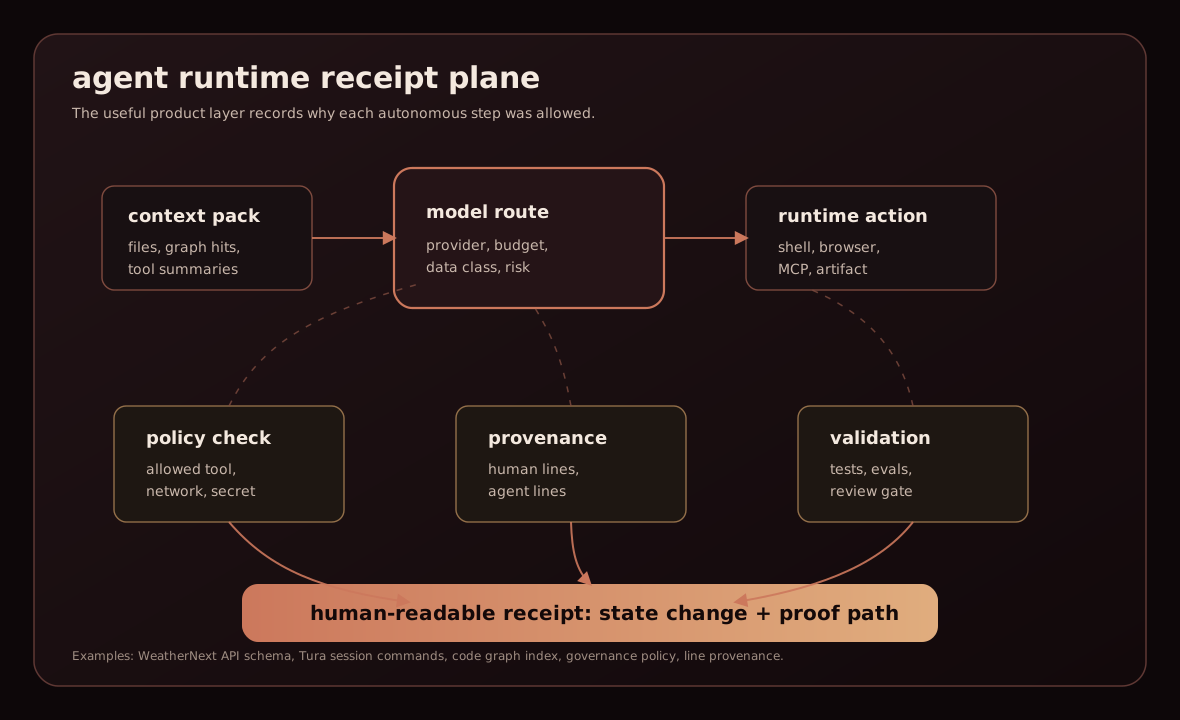
The useful layer sits around the model: context intake, runtime action, policy, state, provenance, and validation. The model can be stronger next month. The receipt plane still has to explain what happened today.
WeatherNext Is the Clean Model Release
WeatherNext caught my eye because it does not sell intelligence as a chat surface. Google DeepMind frames the cyclone work around operational forecasting: stronger tropical cyclone predictions, open-source model code, pretrained model access, and forecast data feeds through Google surfaces. Open-Meteo also exposes WeatherNext 2 ensemble output through an API route.
That is a healthier model story than many agent launches. The model has a data product shape.
I made a small smoke test against Open-Meteo's WeatherNext route:
GET https://ensemble-api.open-meteo.com/v1/ensemble
  ?latitude=25.0330
  &longitude=121.5654
  &hourly=temperature_2m,precipitation
  &forecast_days=2
  &models=google_weathernext2_ensemble
  &timezone=Asia%2FTaipei
The endpoint returned HTTP 200. The response snapped the request to 25.0, 121.5, kept the timezone, and returned the base hourly fields plus ensemble member fields from member01 upward. A daily request for temperature_2m_mean and precipitation_sum also returned HTTP 200. The generationtime_ms field sat around 1.4 to 2.0 ms in my two calls, which I read as API response generation time, not model inference time.
Two wrong endpoints told me more than the happy path:
| Call | Result | Read |
|---|---|---|
/v1/google-weathernext | HTTP 404 | The WeatherNext API is not a separate root path. |
/v1/forecast?models=google_weathernext | HTTP 400 | Open-Meteo's normal forecast route does not accept that model id. |
/v1/ensemble?models=google_weathernext2_ensemble | HTTP 200 | The ensemble API is the consumable shape. |
This is the detail product teams often skip. A model release becomes useful when a developer can make one request, see stable schema, and wire the output into a alerting, planning, or risk system. The repository can contain training code and weights, but the live product value comes from a boring data plane.
The same lesson applies to agents. A coding agent cannot stay an opaque terminal session forever. It needs a runtime data plane: files, commands, browser state, policy decisions, traces, artifacts, and rollback points. Without that, autonomy is a nice story and a poor process.
Claude Code Auto Mode Raises the Receipt Bar
Claude Code's auto mode becoming the default for Pro, Max, and Team plans changes the burden on surrounding tooling. Cross-session messaging points in the same direction. Agents now need to coordinate, resume, and act with less per-step confirmation.
That can be useful. It also moves failure from "the assistant suggested a bad command" to "the assistant took a bad path while the user was not staring at every step."
Auto mode makes receipts a user interface problem:
| Runtime question | User-facing receipt |
|---|---|
| Did the agent read the right files? | File access list, with reasons. |
| Did it use the right context? | Context pack id, trim summary, and omitted-risk note. |
| Did it call a tool with private data? | Tool call trace with policy result. |
| Did it modify a human-owned section? | Provenance diff before patch. |
| Did another agent session send instructions? | Message sender, session id, and accepted scope. |
| Did it stop for a good reason? | Goal state, blocker, or validation failure. |
Most products show a transcript and call it transparency. A transcript is weak evidence. A receipt names the state transition and the gate that allowed it.
My Trial Bench
I kept the test bench small: one Windows machine, one existing Next.js repo, no paid model calls, no secret-heavy setup. That is not a full review. It is enough to catch install smell, command surface, and first-run behavior.
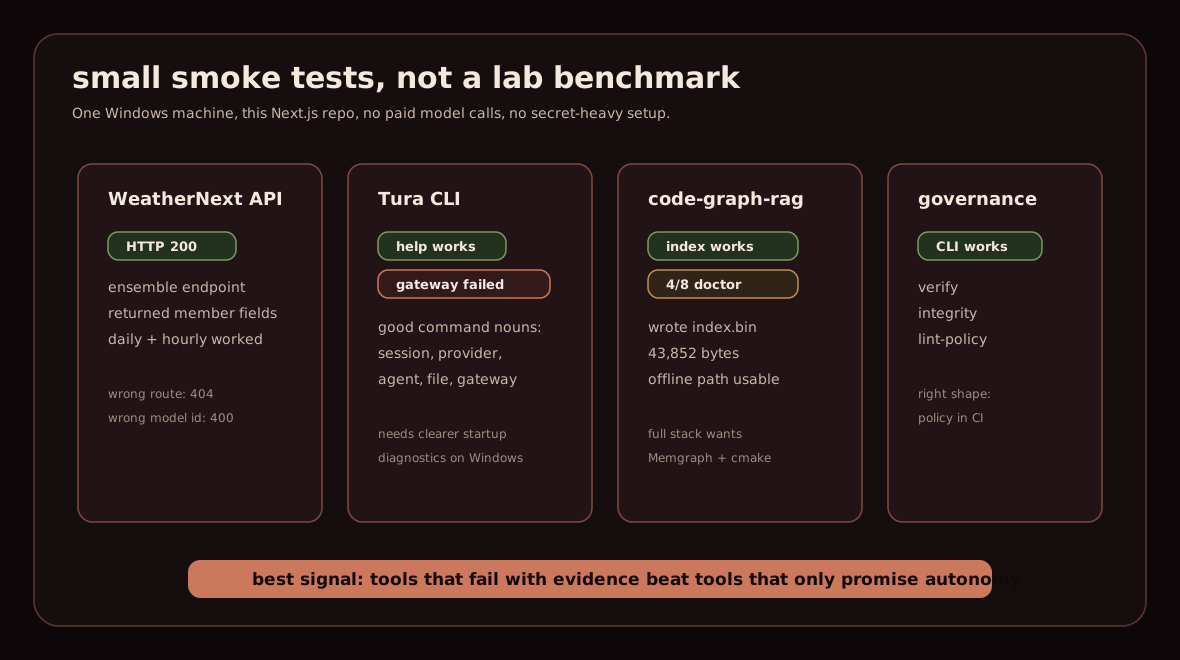
My test bench favored boring checks: can I install it, ask for help, run an offline command, inspect dependencies, and understand failure without reading source for two hours?
Tura
Tura describes itself as an open-source agent runtime harness that can use fewer tokens and improve verifier success on its published DeepSWE and rewrite task set. The headline claim is sharp: Tura Direct reports far fewer aggregate tokens than Codex CLI with similar verifier success, while Tura Balanced spends some of the saved budget on reasoning and reports higher success.
I treat those numbers as a vendor benchmark, not a universal law. The good part is that Tura publishes archived prompts, rounds, tool calls, token usage, patches, and verifier results. That is a receipt-shaped benchmark, even if you still need to reproduce it on your own work.
The npm install path was easy:
npx --yes tura-ai@0.1.35 --help
That returned a real command surface:
run,exec,bash,zsh,shelresume,session,configprovider,agent,persona,projectfile,command,inspect,gateway,completion
This surface is coherent. It exposes sessions, providers, files, commands, and gateway access as first-class nouns. That is what I want from an agent harness.
The next command failed:
npx --yes tura-ai@0.1.35 provider list --json
The error was:
tura: Gateway did not become healthy after startup.
That result matters. Tura may run fine on the maintainer's matrix and on other machines, but my clean Windows first run did not reach a healthy gateway. I still like the architecture direction. I would not put it into a teammate workflow until the startup path gives a crisp diagnostic, a log path, and a one-command self check.
The useful Tura idea is not "use less token." The useful idea is to make token budget, session state, command tools, and verifier output visible enough that a team can reason about the agent as a runtime.
code-graph-rag
code-graph-rag felt more mature at the CLI layer. I ran:
uvx --from code-graph-rag code-graph-rag --help
The help screen exposed a broad but understandable shape:
start,optimize,mcp-serverindex,export,graph-loader,stats,dead-codelanguage,daemon,workspace,doctor
I then ran an offline index against this portfolio repo:
uvx --from code-graph-rag code-graph-rag --quiet index --repo-path . -o <temp>
It completed and wrote a 43,852 byte index.bin. The run also printed:
ast-grep-py unavailable; ast-grep language tier disabled
That is the right kind of failure for a first pass. The offline index still produced an artifact. The missing tier was visible.
doctor gave a more mixed result after I forced UTF-8 output:
4/8 checks passed
It saw Docker, OpenAI key, Gemini key, and ripgrep. It failed Memgraph connection, orchestrator key, Cypher key, and cmake. The first doctor run also hit a CP950 Unicode output issue on this Windows terminal before I set PYTHONIOENCODING=utf-8.
My read: the project has a real code-intelligence core. Offline indexing works. The full interactive graph stack still assumes a heavier local environment than a casual user expects. For agent workflows, that tradeoff is acceptable if the team treats it as shared infrastructure, not a tiny per-user toy.
This category has real value. Agents waste context because they read files like a tired intern with grep. Code graphs can make retrieval more exact: symbol edges, callers, routes, data flow, dead code candidates, and structural replacement. A graph does not guarantee a correct edit, but it gives the agent better evidence before it touches code.
Agent Governance Toolkit
Microsoft's Agent Governance Toolkit landed in the right category for me because it starts with policy and verification, not a new chat loop. I ran:
uvx --from agent-governance-toolkit agent-governance --help
The CLI returned:
agent-compliance verify
agent-compliance integrity
agent-compliance lint-policy
That small surface is a good sign. The repo talks about policy enforcement, identity, sandboxing, and SRE concerns for autonomous agents. The CLI exposes compliance checks, integrity manifests, and policy linting. I have not wired it into a real agent app, but the shape matches the problem.
Agent governance should feel like CI. You define allowed actions, prove artifact integrity, lint the policy, and block release when the agent violates the contract. A governance layer that only writes advice is paperwork. A governance layer that fails builds has teeth.
Prime Agent
Prime Agent is the most ambitious agent runtime I looked at. The docs describe a persistent IPython control environment, recursive subagents, durable harness state, sessions, background agents, compaction, MCP integration through Python skills, and programmatic usage modes.
I did not run it here. The public quick start targets Linux and macOS release artifacts, and the first real session needs subscription login or provider keys. I also saw the latest CI runs I checked return action_required, which tells me the repo is moving fast and not quiet.
The concept is still worth tracking. Prime Agent treats context as variables and subagents as callable functions inside a persistent runtime. That is a serious programming model. It also creates a larger receipt burden. If subagents can call subagents, the system needs a call tree, a state tree, and a policy decision at each edge.
Human vs Agent Provenance
us-vs-them is a small Clojure tool, but the idea is strong: use version history to mark line ranges as human-authored or agent-authored. The README frames human-written lines as islands inside machine-generated sea.
That metaphor is a bit cute. The mechanism is useful.
Agentic editing needs ownership memory. A file can look flat, but the social meaning of each line differs. A hand-written paragraph in a README deserves more friction before an agent rewrites it. A generated block from last session can accept heavier edits. A provenance tool can feed that distinction back into the prompt, patch policy, or review UI.
I did not install the Babashka path on this run. I still rate the project as high-signal because it attacks a real missing receipt: who wrote this line, and how hard should the next agent push on it?
Repos That Passed My Value Filter
I used a plain filter: does the project reduce a specific agent failure mode, or does it give a model output a clean operational surface? Star velocity alone does not pass.
| Project | Value | My caveat |
|---|---|---|
| WeatherNext | Turns a strong ML model into open code, weights, and forecast data products. The Open-Meteo route made the output easy to consume. | Running the model yourself remains a research/infrastructure task. The API route is the practical entry. |
| Tura | Treats token budget, sessions, commands, and benchmark traces as runtime objects. The CLI nouns are well chosen. | The gateway failed on my Windows smoke test. Startup diagnostics need more polish. |
| code-graph-rag | Builds a graph-shaped evidence layer for coding agents. Offline indexing worked on this repo. | Full graph query mode wants Memgraph, keys, cmake, and clean terminal encoding. |
| Agent Governance Toolkit | Moves agent safety toward policy linting, integrity, and compliance checks. | Public preview tools need real integration examples before teams trust them. |
| Prime Agent | A persistent programmable runtime with recursive subagents and durable harness state. | Strong idea, heavy surface. Recursive agents need strong call receipts. |
| us-vs-them | Gives agent editors line-level provenance from git history. | Early and narrow. Best as a policy signal inside other tools. |
| Claude Code auto mode and cross-session messaging | Pushes coding agents toward long-running work and session coordination. | More autonomy means users need better receipts, not longer transcripts. |
I cut a lot of projects from the mental list. Generic "AI agency" packs, huge skill bundles, and free-provider proxies can be useful, but many of them create more surface area before they create proof. A repo that adds twenty agents and no evidence story is debt with a friendly README.
The Receipt Plane
The stack I want looks like this:
task
  -> context pack
  -> model route
  -> policy check
  -> runtime action
  -> artifact write
  -> provenance update
  -> validation gate
  -> human-readable receipt
Each step has a product owner:
| Layer | Owner mindset |
|---|---|
| Context pack | The agent should know what it read and what it skipped. |
| Model route | The system should know why this provider saw this data. |
| Policy check | Security should know which rule allowed the action. |
| Runtime action | Engineering should know which command ran and where. |
| Artifact write | Reviewers should know which files or outputs changed. |
| Provenance update | Future agents should know which lines need care. |
| Validation gate | Users should know why the result moved forward. |
You can implement this with logs at first. Later, the receipt becomes part of the UI. The user should not search a raw transcript to know whether the agent touched .env, rewrote the human-written intro, or sent code to a remote provider.
This also changes evaluation. A benchmark result without trace artifacts tells you too little. Tura's benchmark direction is good because it publishes prompts, rounds, tool calls, token use, patches, and verifier outcomes. You may disagree with the test set, but the evidence shape is better than a scoreboard.
WeatherNext offers the same lesson from another domain. A forecast model gains product value when it enters a stable data surface with documented variables, schedule, access paths, and limitations. Agent models need that same level of operational wrapping.
A Small Architecture I Would Ship
For a real coding-agent team, I would start with a modest receipt plane:
- Build a context manifest for each turn: files read, snippets selected, graph query ids, tool output summaries.
- Route models through a policy table: provider, data class, max autonomy, tool permissions, retention setting.
- Require tool-call receipts: command, cwd, env redaction, network target, exit code, artifact ids.
- Mark file ownership: human-authored, agent-authored, mixed, generated, vendored.
- Attach validation: tests, typecheck, lint, screenshot check, human review, or explicit skip reason.
- Show a compact receipt after each run, with links to raw logs for debugging.
This is not large platform work. A small team can build the first version with JSON files and CI artifacts. The key is discipline: the receipt exists before the agent earns more autonomy.
The temptation is to buy a bigger agent and call the governance solved. That will age badly. Stronger models make receipts more valuable because they take longer paths and touch more state.
My Take
The useful agent work right now sits around the model.
WeatherNext shows a model release with an operational data shape. Claude Code's auto mode pushes autonomy into normal coding workflows. Tura tries to make session and token budget visible. code-graph-rag gives coding agents structural evidence. Agent Governance Toolkit gives policy a CLI. Prime Agent explores a persistent programmable runtime. us-vs-them gives human authorship a computable boundary.
Those pieces point to the same product requirement: agent systems need receipts.
A receipt is not the final answer. It is the proof path. It lets you debug bad work, trust good work, and decide when the agent can run without a human hand on every command.
That is where I would spend engineering time: less heroic autonomy, more boring evidence.
Sources
- Google DeepMind: WeatherNext AI model achieves breakthrough in forecasting cyclones
- Google Developers: WeatherNext models
- Google Developers: Accessing WeatherNext forecasts
- Open-Meteo: Google WeatherNext API
- GitHub: google-deepmind/weathernext
- Simon Willison: OpenAI accidental attack against Hugging Face timeline
- Simon Willison: Auto mode is now the default in Claude Code
- Claude Code docs: Cross-session messaging
- GitHub: Tura-AI/tura
- Tura benchmark evidence record
- GitHub: vitali87/code-graph-rag
- GitHub: microsoft/agent-governance-toolkit
- GitHub: PrimeIntellect-ai/prime-agent
- GitHub: eighttrigrams/us-vs-them