Tracing the Agent Supply Chain
A field note on FLUX 3, Claude Cookbook, Hetzner inference, open weights, token compression, and agent projects that expose model-work control points.
The strongest signal in this field note was not one more coding agent. It was the supply chain around agent work becoming visible.
The useful source material clustered around model capability, inference availability, open-weight politics, cookbook-style vendor guidance, token budgets, and the recurring lesson that a fluent AI workflow still takes a long time to make reliable. The useful repos exposed control points around agents: model routing, session memory, web evidence, harnesses, domain pipelines, and cost filters.
My read: serious agent products are becoming less like a chat app with tools and more like a supply chain.
model weights
  -> inference provider
  -> router and budget policy
  -> context intake
  -> memory and work queue
  -> tool/browser/runtime action
  -> artifact
  -> review, audit, and retry
I treated public announcements, infrastructure notes, repo docs, and benchmark write-ups as leads, then checked whether each item exposed a supply-chain node that a product team could measure.
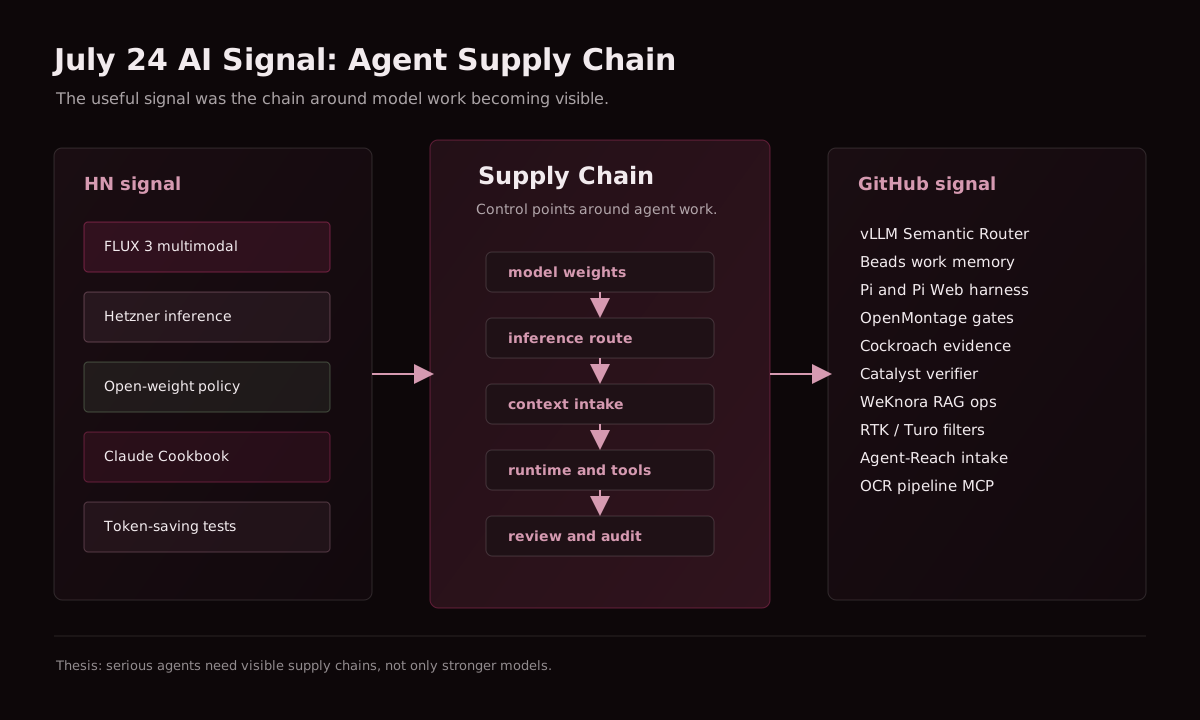
My read: the useful signal was the chain of model supply, inference supply, context supply, runtime supply, and review supply becoming a product surface.
Models Are Becoming World Interfaces
FLUX 3 from Black Forest Labs gave the clearest model-surface example.
The important part is not only that FLUX 3 moves beyond static image generation. It is that BFL is framing the model as a multimodal foundation model that jointly learns from images, video, and audio, with action-prediction ambitions attached to the same family.
That matters because the boundary between "media model" and "agent model" is getting blurry.
If a model can produce synchronized video and audio, understand motion, and eventually map observations to actions, then the product category is no longer only creative tooling. It starts touching simulation, robotics, training data, UI testing, physical-world planning, and embodied automation.
The FLUX 3 x Mimic follow-up made that explicit: video-action models are being positioned as a path from generated motion to robot behavior. The robotics claims need independent evidence, but the direction is clear. Models are becoming interfaces to world state, not only text or images.
The practical takeaway for agent builders is simple:
| Model output | Product consequence |
|---|---|
| Text | Needs citations, tool calls, and review. |
| Code | Needs tests, diff review, and ownership. |
| Image/video/audio | Needs provenance, licensing, and quality gates. |
| Action prediction | Needs safety boundaries, replay, and real-world validation. |
A chat transcript is not enough evidence for any of those outputs. As models move closer to action, the supply chain around the model becomes more important.
Inference Is Becoming a Commodity Layer
The next HN signal was Hetzner working on LLM inference.
This was not a giant frontier-model launch. That is why it was interesting. A commodity hosting provider experimenting with an OpenAI-compatible inference API says something about where the market wants to go: teams want inference to look like normal infrastructure.
The details are still early. The reported service was experimental, limited, and not something I would build production workflows on yet. But the direction is important:
frontier API
  + open-weight model
  + commodity GPU provider
  + local runtime
  + router
  = actual agent execution fabric
The supply chain question becomes:
| Routing decision | Why it matters |
|---|---|
| Which provider sees the prompt? | Privacy and policy. |
| Which provider runs cheap background work? | Cost and latency. |
| Which model is allowed to call tools? | Authority and safety. |
| Which model gets long context? | Budget and reliability. |
| Which path is self-hostable? | Vendor and availability risk. |
This is why vLLM Semantic Router was one of the more valuable projects in this group. It is not another chat UI. It is pointed at heterogeneous inference: route requests across models based on signals, preferences, workload type, and production constraints.
That is the right category. The hard part is not adding another provider dropdown. The hard part is making routing decisions measurable, auditable, and aligned with data sensitivity.
Open Weights Are Not Just Ideology
Public policy material also clustered around open weights:
- NVIDIA's Open Weights and American AI Leadership PDF
- Microsoft's open-weight policy page
- Jensen Huang linking the argument
- open-weight model announcements and discussion
- hosted-model market news around OpenRouter
The engineering read is that open weights are becoming part of deployment strategy.
Open weights matter when a team needs:
- local inference for private data
- self-hosted fallback when API access changes
- fine-tuned domain models
- reproducible evaluation
- lower-margin batch workloads
- provider independence
- sovereign or regulated deployment paths
That does not make open weights automatically safe or cheap. It means model availability is now a supply-chain question.
The strongest products will probably not be "all open" or "all hosted." They will route by workload:
| Workload | Likely model route |
|---|---|
| private low-risk drafting | local or self-hosted |
| cheap background extraction | budget hosted or local |
| high-stakes reasoning | frontier hosted plus review |
| domain batch processing | open-weight model tuned and measured |
| tool-calling agent action | model plus policy gateway |
The router is becoming the place where technical, economic, and legal constraints meet.
Cookbooks Are Becoming Vendor Control Surfaces
The Claude Cookbook HN item looked boring at first. It is just practical guides and code examples.
But that is exactly why it matters.
When a model vendor maintains recipes for prompting, tool use, multimodal inputs, skills, document generation, and agentic workflows, the cookbook becomes part of the product interface. It shapes how developers build with the model. It quietly teaches what the vendor thinks "good usage" looks like.
That pairs with the GitHub trend around skills:
mattpocock/skillsComposioHQ/awesome-claude-skillssigilagent/sigil- HN posts about audited coding skills
- prior-day signals like SkillOpt
Natural-language instructions are becoming operational artifacts. A SKILL.md can change what an agent reads, which tools it uses, how it handles uncertainty, and whether it asks for permission.
That means skills deserve the same boring treatment as code:
| Skill concern | Required control |
|---|---|
| Behavior change | version history and changelog |
| Tool access | permission review |
| Eval claims | held-out tasks |
| Safety language | adversarial examples |
| Deployment | rollback path |
The useful direction is not "collect more prompts." It is "make the instructions that control agents inspectable, testable, and reversible."
Token Saving Is a Measurement Problem
RTK and Turo were both interesting because they point at a real pain: coding agents burn context on noisy terminal output.
The idea is reasonable. Agents do not need every progress bar, every successful test line, every repeated package-manager warning, or every giant directory listing. A command-output proxy can filter noise before it enters the model context.
But this category needs evidence, not loose claims.
JetBrains' RTK benchmark was useful because it tested the claim rather than repeating it. Their result was not flattering to the headline savings claim: the measured cost did not improve in the paired benchmark, and low-effort runs got more expensive.
That does not make output filtering useless. It means token saving has to be measured at the workflow level.
raw shell output
  -> filtered shell output
  -> model behavior
  -> task success
  -> retry count
  -> final cost
If filtering saves tokens but causes the agent to miss the one line that mattered, the system may spend more through retries. If filtering preserves the error and removes the noise, it can be useful. The difference is empirical.
My rule: treat token compression as a lossy system component. It belongs in the router/budget layer, but only behind benchmarks, escape hatches, and task-level outcome tracking.
Repository Triage
The project set was busy, but a lot of it was either already covered in earlier field notes or too broad to trust from the README alone.
The repos worth a closer look were the ones that exposed a real control point in the agent supply chain.
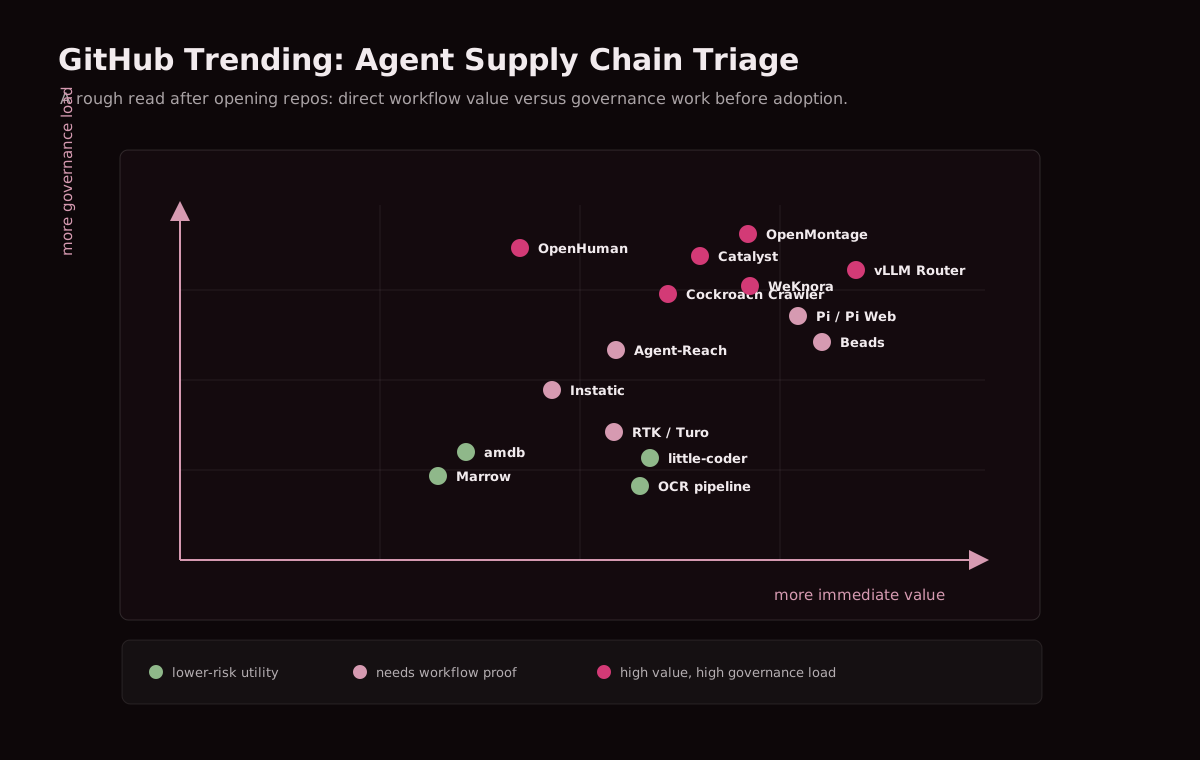
My rough triage after opening repos. High value means the project points at a real bottleneck. High governance load means adoption requires policy, measurement, or operational discipline.
| Repo | My read | Why it has value | Main caveat |
|---|---|---|---|
| vLLM Semantic Router | High-signal inference control | Mixture-of-models routing is the right layer for heterogeneous inference. The project has docs, releases, papers, and a production-stack integration story rather than only a demo. | Routing is a trust boundary. Teams need policies for data sensitivity, fallback quality, logging, and provider exposure. |
| Beads | Practical agent memory | A Dolt-backed graph issue tracker for agents is a concrete answer to long-horizon work: dependencies, status, messages, sync, compaction, and machine-readable state. | It asks teams to adopt another work-tracking primitive. Good memory can become stale authority unless humans keep ownership clear. |
| Pi / Pi Web | Strong harness surface | Pi has an agent runtime, coding CLI, provider API, permissions/containerization notes, and supply-chain hardening. Pi Web adds session browsing, worktree switching, cost/context visibility, and model config. | Broad agent harnesses live or die by daily ergonomics. Permission defaults, update trust, and session privacy need close review. |
| OpenMontage | Best domain-agent signal | It is not just "AI video." The README talks about production pipelines, tool selectors, cost estimation, approval gates, pre-compose validation, post-render review, and audit trails. That is the right shape for creative agents. | Huge surface area and AGPL license. Output quality and cost claims should be tested on real briefs before any team depends on it. |
| Cockroach Crawler | Good evidence boundary | It frames web access as bounded evidence collection: page budgets, origin controls, DNS/private-network checks, robots behavior, content hashes, provenance, JSON/JSONL output, and MCP. | Very young and low adoption. Crawling policy and content permissions still need human decisions. |
| Imbue Catalyst | Serious AI-scientist framing | The README is unusually honest about fit: verifiable phenomena, programmatic experiments, falsification loops, competing theories, and explicit non-goals. That is the right bar for research agents. | Still depends on well-scoped problems and runnable experiments. It cannot turn vague science into truth. |
| WeKnora | Mature RAG/agent platform | Workspace RBAC, audit logs, runtime queues, model governance, MCP, wiki generation, tracing, and integrations make it more serious than a RAG demo. | License metadata is not clean from GitHub API, and the README itself warns against public exposure. Treat as internal infrastructure. |
| RTK / Turo | Useful pressure signal | Command-output filtering attacks a real cost/context problem for coding agents. The category is worth measuring. | Savings claims are not enough. Benchmark against full task outcomes, not only token counters. |
| Agent-Reach | Useful but risky web intake | It packages practical ways for agents to read web pages, YouTube, GitHub, RSS, and social platforms when normal APIs are painful. | Cookies, scraping, anti-abuse systems, and terms of service make this a governance-heavy tool. "Free access" is not the same as safe access. |
| little-coder | Interesting small-model harness | Optimizing a coding harness around smaller models, sub-coders, plan mode, read-before-edit, and local model setup is a useful experiment. | The value depends on actual task success and maintenance. Small-model harnesses need clear escalation rules. |
| production-ocr-course | Strong pipeline artifact | A Rust/vLLM/Redis/KEDA OCR architecture with throughput notes, scaling strategy, and MCP wrapping is a useful reference for document AI systems. | It is more course/reference architecture than turnkey product. Benchmark claims need local reproduction. |
| OpenHuman | Ambitious personal agent OS | Local memory, workflows, routing, background loops, integrations, and privacy mode point at a real product category. | Very broad claims, many integrations, and high personal-data sensitivity. I would watch it before trusting it. |
| Instatic | Tangential but thoughtful | An agentic CMS where AI edits real page nodes, not screenshots or loose code, is a useful domain-agent pattern. Audit logs and roles help. | It is a CMS first, not agent infrastructure. Evaluate for the CMS, not only the AI pitch. |
| amdb / Marrow | Small but aligned | Local code-context MCP and semantic search over coding sessions both address agent evidence retrieval. | Tiny adoption and overlapping category. Worth testing only if the exact context problem is painful. |
The strongest pattern is that agents need supply-chain nodes, not just bigger prompts.
Agent Memory Is Becoming a Work Queue
Beads stood out because it does not pretend memory is an undifferentiated vector store.
It treats agent memory as work structure:
- issues
- dependencies
- status
- messages
- branching
- sync
- compaction
- machine-readable commands
That is a much better default for coding agents than a pile of Markdown TODOs. Long-horizon work is not only "remember this fact." It is "this task blocks that task, this branch tried one approach, this review comment is unresolved, this decision was superseded."
The product lesson is direct:
agent memory should be operational state,
not only semantic recall.
A memory system for agents should answer:
| Question | Why it matters |
|---|---|
| What is ready to work on? | Prevents wandering. |
| What depends on what? | Prevents wrong-order edits. |
| What was already tried? | Prevents loops. |
| Who owns the decision? | Preserves accountability. |
| What can be compacted? | Saves context without deleting history. |
This is why Beads felt more valuable than many flashier repos in the list.
Web Access Needs Evidence, Not Ambient Browsing
Agent-Reach and Cockroach Crawler represent two versions of the same pressure.
Agents need to read the web. They need docs, issues, videos, discussions, social reaction, RSS, and pages that are hostile to normal scraping. But the naive answer - give the model a browser and hope it behaves - is too broad.
Cockroach Crawler had the better governance taste. Its README emphasizes bounded crawls, origin allowlists, private-network protections, robots behavior, content hashes, provenance, and MCP tools that cannot widen deployment-owned budgets unless the operator allows it.
That is the pattern I want in agent web intake:
allowed source
  -> bounded retrieval
  -> normalized evidence
  -> metadata and hashes
  -> warnings and failures
  -> model-readable summary
Agent-Reach is useful because it packages practical access paths. Cockroach Crawler is useful because it names the boundary.
The product should probably combine both instincts: make web evidence easy to collect, but never give model input the power to widen the crawl, open private networks, or silently reuse logged-in state.
Domain Agents Need Gates
OpenMontage was the most interesting domain-agent repo in this group.
The easy read is "agentic video production." The better read is that it has a serious domain workflow:
- reference analysis
- production pipelines
- provider selection
- cost estimation
- approval gates
- quality checks
- pre-compose validation
- post-render review
- audit trail
That is what domain agents need.
A good domain agent is not a chat box with a specialized prompt. It is a workflow with domain-specific gates. For video, that means checking visual quality, pacing, subtitles, audio levels, black frames, provider cost, and whether the final output matches the brief. For scientific research, Catalyst frames the same idea as verifiable experiments, falsification agents, and competing hypotheses. For OCR, the production-ocr-course repo frames it as routing, batching, scaling, layout handling, and internal network boundaries.
The common rule:
domain agent = model + tools + domain gates + replayable evidence
Without the gates, it is just a fluent demo.
The App Took a Year Signal
HN also had I Tried Building a Real App with AI. It Took a Year and the Uncle Bob thread about not reading code written by agents.
Those items are less about one specific tool and more about the emotional mismatch in the market.
The pitch is "AI makes software easy." The daily reality is:
- agents make many plausible changes
- review load moves around
- hidden assumptions still matter
- context loss is expensive
- local conventions are hard
- production polish takes time
- failure modes become harder to attribute
That does not mean agents are useless. It means the supply chain has to absorb the work.
Agents need:
- a spec surface
- a repo-understanding surface
- a session memory surface
- a runtime permission surface
- a review surface
- a budget surface
- a way to compare attempts
The people getting value from agents are usually not the people pretending code review is obsolete. They are the people building harnesses around the work.
Validation Harness
The supply-chain view becomes useful when each node has a small measurable check:
rtk bench ./fixtures/coding-tasks --compare raw,filtered --out out/token-filter.json
beads import .agent/tasks --out out/work-graph.json
semantic-router eval routes.yaml fixtures/model-routing.jsonl --out out/router-score.json
crawler fetch https://example.com/docs --allow-origin example.com --max-pages 20 --jsonl out/evidence.jsonl
openmontage validate brief.yaml --precompose --out out/video-gates.json
The report should tie each supply-chain node to a failure mode:
{
  "token_filter": {"final_success_delta": -0.02, "retry_delta": 1, "billed_token_delta": -0.31},
  "memory": {"blocked_tasks": 3, "stale_edges": 1},
  "routing": {"policy_violations": 0, "false_local_confidence": 2},
  "web_evidence": {"pages": 18, "private_network_blocks": 1, "content_hashes": true},
  "domain_gate": {"precompose_passed": false, "failed_gate": "subtitle-timing"}
}
The goal is not more autonomy. It is a supply chain that can tell you what happened.
Supply-Chain Contract
FLUX 3 made the model surface more multimodal. Hetzner hinted that inference may become ordinary infrastructure. Open-weight policy made model availability a strategic deployment question. Claude Cookbook showed vendor recipes becoming control surfaces. Token-saving tools reminded everyone that cost claims need benchmarks. Routers, harnesses, memory systems, web evidence tools, domain pipelines, and personal agent OS attempts fill in the control points.
Those are not separate stories.
They are all pieces of the same supply chain:
- where the model comes from
- where inference runs
- how requests are routed
- what context is admitted
- what memory survives
- what tools can act
- what artifacts are produced
- what gates verify them
- what costs and traces remain
The serious agent products will not only ask "which model is best?"
They will ask "which parts of the supply chain are visible, governed, and measurable?"
That is where the value is moving.
Sources
- Black Forest Labs: FLUX 3
- Black Forest Labs: FLUX 3 x mimic
- Anthropic: Claude Cookbook
- Sliplane: Hetzner Inference first look
- NVIDIA: Open Weights and American AI Leadership PDF
- Microsoft: Open weights and American AI leadership
- Harness Handbook
- JetBrains: RTK Claude Code Token Savings
- GitHub: Turo
- GitHub: vLLM Semantic Router
- GitHub: Beads
- GitHub: Pi
- GitHub: Pi Web
- GitHub: OpenMontage
- GitHub: Cockroach Crawler
- GitHub: Imbue Catalyst
- GitHub: WeKnora
- GitHub: Agent-Reach
- GitHub: little-coder
- GitHub: production-ocr-course
- GitHub: OpenHuman
- GitHub: Instatic
- GitHub: amdb
- GitHub: Marrow