The Work Ledger Behind Agent Sessions
A field note on Tao's ChatGPT math thread, open-weight policy, AI capex, tokenization, credential gateways, semantic IDE tools, spec workflows, and agent workspaces.
This field note starts with a useful shift: serious agent work is becoming less like chat and more like a work ledger.
Terence Tao's public ChatGPT conversation made the upside visible. A model can now be a useful reasoning partner even near the edge of serious mathematics. But the interesting artifact is not "the model said something smart." It is the transcript, the counterexample, the checks, the places where the human mathematician challenged the chain, and the path from plausible idea to verifiable proof.
The tooling side pointed in the same direction. The strongest projects were not generic agent demos. They were work surfaces: agent workspaces, browser spaces, deterministic review harnesses, semantic code tools, spec folders, skill optimizers, credential gateways, local model runtimes, and communication logs where humans and agents share the same evidence.
My read: if agents are going to do real work, the product surface is not the chat box. It is the ledger around the work.
I treated public essays, policy coverage, repo docs, and shared technical artifacts as leads, then included projects only when they exposed a record surface: identity, evidence, credentials, runtime boundaries, review comments, cost traces, or skill versions.
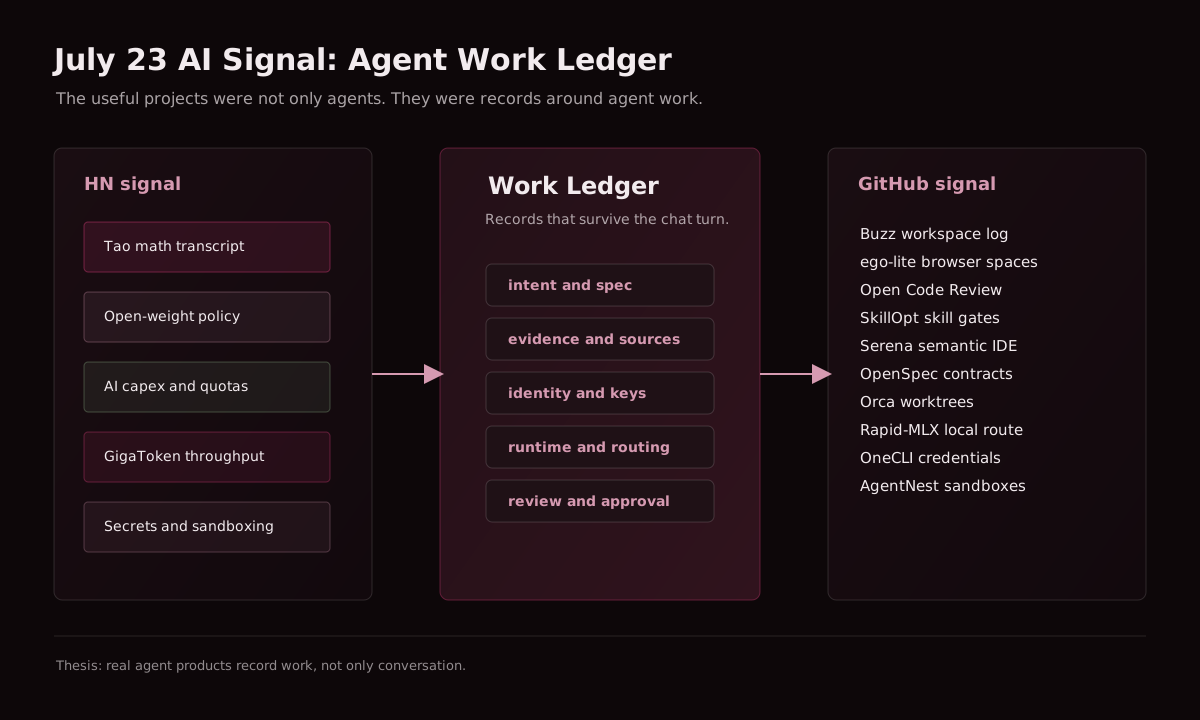
My read: the day's useful signal was not "agents can do everything." It was that agent work needs durable records: identity, evidence, specs, credentials, runtime boundaries, review comments, cost traces, and skill versions.
Model-Assisted Proof Still Leaves a Ledger
Terence Tao's public ChatGPT conversation about the Jacobian Conjecture counterexample gave the cleanest example.
That story is easy to overstate in both directions. The weak version is "ChatGPT solved hard math." The dismissive version is "nothing matters until a human checks it." The more useful version sits between them:
model-assisted exploration
  -> human skepticism
  -> transcripted reasoning
  -> independent verification
  -> durable mathematical artifact
That is a work ledger.
The model's value is not that it replaces proof. Its value is that it can participate in the search process: propose paths, connect facts, try reductions, and keep moving when the human is testing a line of thought. But mathematics is an unusually clean domain because the end state still demands proof. The transcript is not the result. It is evidence about how the result was reached.
Most agent products are not that disciplined. A coding agent changes files. A research agent summarizes sources. A browser agent clicks through a workflow. A finance agent drafts an action. In all of those cases, the product has to preserve enough of the work that a person can ask:
| Question | Why it matters |
|---|---|
| What did the agent see? | Context determines the shape of the answer. |
| Which model saw it? | Routing is a data-governance decision. |
| Which tools were used? | Tool authority is where text becomes action. |
| What evidence supports the result? | Plausibility is not verification. |
| What was rejected or escalated? | Failure paths are part of the work. |
| Who approved the final artifact? | Autonomy needs ownership. |
The Tao thread was compelling because the work was inspectable. That should be the bar for less formal domains too.
Policy and Capex Are Now Part of the Model Interface
HN also had a cluster of stories about open weights, AI spending, and model-market power:
- startup founders urging the U.S. government not to shut off Chinese open-weight AI
- OpenAI and Anthropic aligning against open-weight model risk in policy debates
- AI companies pushing more debt off balance sheet
- Alphabet cash-burn concerns as AI spending climbs
- the U.S. Army running into "unlimited" AI token limits
- Anthropic subsidizing coding-agent usage at a large multiple
These are not separate from engineering.
If your agent system depends on one hosted frontier model, one pricing assumption, one political export regime, or one provider's "unlimited" plan, that is not just vendor risk. It changes what your product can safely do.
The engineering shape is becoming clearer:
| Constraint | Product consequence |
|---|---|
| Open-weight access | Determines whether local and self-hosted paths exist. |
| Provider price changes | Changes which workflows are economically viable. |
| Token quotas | Turns background autonomy into a budgeted resource. |
| Capex pressure | Pushes providers to change terms, caching, routing, and tiers. |
| Policy restrictions | Can turn model availability into a supply-chain problem. |
This is why GigaToken, Rapid-MLX, Cactus Hybrid, Petals, Millwright, and OmniRoute-style routing keep showing up around the same time. They are all different answers to the same pressure: agents need cheaper, faster, more controllable execution paths.
The mistake is treating cost as a dashboard metric after the product is built. For agents, cost is part of the permission model. If a task can fan out across five worktrees, drive a browser, call a cloud model, and inspect a large repo, then "how much are we willing to spend?" belongs next to "what is this agent allowed to touch?"
Tokenization Was the Most Boring Important Repo
GigaToken: ~1000x faster language model tokenization was the most infrastructure-shaped HN repo.
The README's claim is simple: language model tokenization at GB/s, with compatibility modes for Hugging Face tokenizers and tiktoken, and a faster native API that avoids Python overhead by letting the Rust implementation read data directly.
That is not glamorous. It is also exactly the sort of bottleneck that matters when the market stops being impressed by one-off demos.
Tokenization sits under:
- pretraining and post-training data pipelines
- evaluation harnesses
- RAG indexing
- log ingestion
- context filtering
- dataset cleaning
- local model serving
If an agent company says it has an enormous private corpus, an eval suite, a memory layer, or a replay system, the boring throughput work matters. The model call is only one part of the system. The rest is moving text, slicing it, validating it, and preserving enough structure that the next run can be compared to the last one.
My caveat is the usual one for performance repos: reproduce the numbers on your hardware, with your tokenizers, your files, and your compatibility requirements. A 1000x headline can be true in one path and less relevant in another.
Still, this is a high-signal kind of repo. It attacks a real floor in the stack.
Small Models Need Honest Exits
Cactus Hybrid was interesting because it treats local inference as a routing problem rather than a religion.
The repo's idea is that small on-device models should carry a confidence score in structured data. If confidence is high, answer locally. If confidence is low, hand off to a bigger model.
That is the right instinct:
if confidence < threshold:
    escalate_to_stronger_model()
else:
    answer_locally()
The hard part is calibration. A confidence number is only useful if it predicts failure in the situations your product faces. A local model that is confidently wrong is worse than a slower cloud model. A router that escalates too often loses the privacy and cost advantage. A router that escalates too late turns cheap inference into hidden quality debt.
This also connects to Rapid-MLX, which trended on GitHub's Python list. Rapid-MLX is a local AI engine for Apple Silicon with OpenAI and Anthropic-compatible routes, prompt caching, tool-calling support, and setup paths for agent CLIs. It is valuable because local inference becomes much more practical when the server speaks the same wire protocol as the hosted APIs agents already know how to call.
The useful pattern is:
| Layer | Good direction | Required proof |
|---|---|---|
| Local runtime | Drop-in API for existing tools. | Real latency and compatibility tests on your machines. |
| Confidence | Structured self-assessment. | Calibration against your task distribution. |
| Routing | Escalate when local is not enough. | False-negative measurement and replay. |
| Privacy | Keep low-risk work local. | Clear policy for what can leave the device. |
Local models do not need to beat frontier models everywhere. They need to be honest enough to know when they should not be used.
Repository Triage: Work Surfaces
The repository set had repeats from prior field notes: OmniRoute, World Monitor, Kronos, RuView, pi-web, LikeC4, text-to-cad, and the Claude skills catalog. I did not re-review those in depth because they were already covered.
The new or newly relevant projects were more interesting as a group. They describe the workbench around agents.
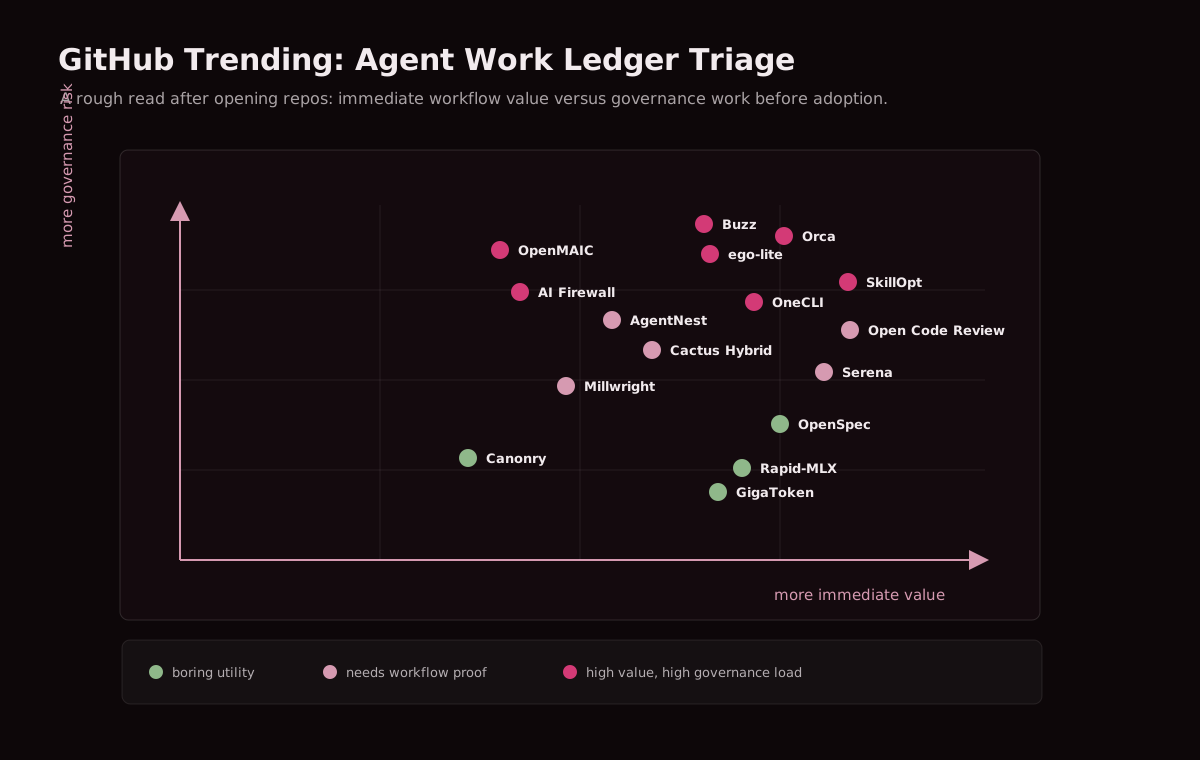
My rough triage after opening the repos. High value does not mean "install immediately." It means the project points at a real bottleneck in agent work.
| Repo | My read | Why it has value | Main caveat |
|---|---|---|---|
| Buzz | Ambitious work ledger | A self-hostable workspace where humans, agents, workflows, repos, patches, approvals, and messages share one signed event log. This is the clearest "agents need rooms, not just chats" repo of the day. | Very broad product surface. The README is more vision than hardened operating history; compliance and tenancy claims need real deployment proof. |
| ego-lite | Strong browser-surface idea | A browser where agents get isolated Spaces while still using the user's real browser context. It targets a real pain: agent browser automation fighting the user's tabs and logins. | Letting agents inherit browser state is powerful and risky. Cookie/session boundaries, consent, audit logs, and stop controls need close inspection. |
| open-code-review | High-signal harness | Alibaba's review tool combines deterministic file selection, rule matching, bundling, positioning, reflection, and LLM review. The precision-first framing is much healthier than "agent reviews everything." | The benchmark claims should be reproduced on your language mix. The README explicitly trades recall for precision; that is a product choice, not a universal win. |
| SkillOpt | Very important direction | Treats natural-language skills as trainable artifacts with rollouts, validation gates, rejected-edit buffers, and deployable best_skill.md files. This is the right level of seriousness for instruction evolution. | Optimizing skills can optimize the wrong behavior if the eval is weak. Skill updates need ownership, changelogs, rollback, and policy review. |
| Serena | Practical coding-agent substrate | MCP server with symbol-level retrieval, editing, refactoring, and debugging through LSP or JetBrains backends. Agents need IDE-level operations, not only grep and line-number edits. | Tool installation changes agent power. Language-server quality, project indexing, and tool permission boundaries matter. |
| OpenSpec | Useful contract layer | Spec-driven development for AI coding assistants. It pushes agents to create proposals, requirements, scenarios, design notes, and task lists before code changes. | Specs can become ritual if humans stop reading them. The value is in reviewable requirements, not in adding folders. |
| Orca | Real agent-ops surface | Runs Codex, Claude Code, OpenCode, and Pi side by side in isolated worktrees, with review, mobile monitoring, terminals, SSH worktrees, and diff comments. | Parallel agents multiply review load. The product is valuable only if comparison, merge, and accountability stay disciplined. |
| Rapid-MLX | Useful local runtime | Apple-Silicon-native local model server with OpenAI/Anthropic-compatible endpoints and agent CLI integrations. Good shape for private or cheap inner-loop work. | Apple Silicon only. Performance and tool-calling claims need local benchmarks with the actual models you would route to it. |
| OneCLI | Strong security boundary | Credential gateway and vault for agents. Agents get placeholder keys; the gateway injects real credentials and keeps an audit point. | A credential proxy becomes critical infrastructure. HTTPS interception, storage, auth, and rotation model need careful review before team use. |
| GigaToken | Boring foundation | Tokenization throughput is a real pipeline bottleneck. Drop-in compatibility plus a faster native API is the right pairing. | Benchmark on your data and confirm exact token parity where compatibility matters. |
| Cactus Hybrid | Good routing primitive | Confidence-carrying local models make edge/cloud handoff explicit instead of pretending small models are always enough. | Confidence calibration is the entire product. Bad confidence is worse than no confidence. |
| AgentNest | Worth watching | Self-hosted disposable agent sandboxes with egress allowlists, audit events, stateful sessions, and escape tests. | Early and small. Containers share the host kernel; threat model needs to match the workload. |
| Millwright | Clean router shape | Self-hosted LLM router focused on policy, cache affinity, and spend control, with explicit roles rather than opaque orchestration. | Very young. Routing policy is useful only if teams maintain prices, model roles, and risk headers. |
| AI Firewall | Honest MVP | Security gateway for LLM traffic with DLP, prompt-injection filtering, stream redaction, audit logs, and a clear "what is real" table. | Deterministic regex/automaton detection is intentionally limited. Treat as a baseline, not a full prompt-injection solution. |
| Canonry | Interesting market signal | Agent-first AEO/AI visibility platform tracking how answer engines cite a site, with CLI, MCP, reports, traffic, and approval gates. | More marketing/SEO operations than ML infrastructure. Useful if AI search visibility matters; otherwise a distraction. |
| OpenMAIC | Domain agent product | Multi-agent classroom that generates lessons, slides, quizzes, simulations, project-based learning, and teacher/peer agents. | Education agents need learning-outcome evidence, not just impressive generation. |
The common thread is not "one more agent." It is the workspace around the agent.
The Work Ledger Pattern
If I compress the day into one architecture, it looks like this:
request
  -> spec / intent record
  -> evidence intake
  -> identity and credential policy
  -> model and runtime route
  -> tool / browser / sandbox action
  -> artifact
  -> review comment or approval
  -> trace, cost, and memory
That is a work ledger. Different repos implement different rows:
| Ledger function | Example signal |
|---|---|
| Intent and requirements | OpenSpec |
| Human and agent workspace | Buzz, Orca |
| Browser execution | ego-lite |
| Code understanding | Serena, open-code-review, code-review-graph |
| Credential boundary | OneCLI |
| Runtime boundary | AgentNest, AI Firewall |
| Model routing and budget | Millwright, Cactus Hybrid, Rapid-MLX, OmniRoute |
| Token/data throughput | GigaToken |
| Skill evolution | SkillOpt, Ingot-style evidence gates |
| Domain packaging | OpenMAIC, Kronos, RuView, World Monitor |
The reason this matters is simple: chat is a terrible system of record.
Chat is good for intent. It is not enough for:
- deciding which model is allowed to see private code
- proving which sources supported an answer
- recording why a branch was merged
- keeping credentials out of agent context
- comparing five agent attempts across worktrees
- applying a spec across multiple repos
- remembering what a skill changed and why
- replaying a browser task after a failure
- measuring whether a local model should have escalated
A serious agent product needs a place where all of those become first-class records.
The Browser Is Becoming an Agent Workbench
ego-lite stood out because browser automation is usually awkward in a very human way. The agent and the user fight over state: logins, tabs, focus, cookies, extensions, and the meaning of "done."
The browser is not just a rendering engine for agents. It is a workspace containing credentials, private history, active sessions, and live actions.
That means a good agent browser has to answer questions that Playwright scripts do not normally answer:
| Browser question | Why it matters |
|---|---|
| Does the agent have its own space? | Prevents the agent from taking over the user's tabs. |
| Which cookies can it use? | Browser state is credential state. |
| Can the user watch or stop it? | High-authority actions need visible control. |
| What did the agent click? | Browser work needs replay. |
| How does it prove completion? | Screenshots alone are often insufficient. |
ego-lite's value is the product shape: shared browser, isolated agent spaces, and agent-oriented APIs. The risk is the same shape. Giving an agent access to real browser state is useful because it is close to power. That is exactly why it needs a ledger.
Code Review Is a Harness Problem
open-code-review and the Humanlayer essay Why Software Factories Fail (or: harness engineering is not enough) made a useful pair.
The Humanlayer piece argues against a naive software-factory view where enough harnesses and agents automatically produce good software. open-code-review shows a more grounded version: constrain the parts that should be deterministic, then use the model where judgment and context retrieval matter.
That distinction is important.
A general coding agent asked to "review this PR" has too much freedom:
- it can skip files
- it can over-focus on style
- it can report comments on wrong lines
- it can miss cross-file implications
- it can produce noisy findings that reviewers learn to ignore
open-code-review's core design is a better shape:
deterministic file selection
  -> deterministic grouping and rules
  -> agent context retrieval
  -> structured finding
  -> positioning and reflection modules
  -> human review
The broader lesson is not that every team should adopt this exact tool. The lesson is that agent products become better when the harness carries hard constraints and the model spends attention where language and judgment help.
Skills Are Becoming Mutable Software
SkillOpt was the most important skill-related repo in this group.
The premise is uncomfortable but correct: if a natural-language skill changes how an agent works, then that skill is executable behavior. It deserves training discipline, validation gates, version history, and rollback.
That is a sharp contrast with the current casual pattern:
- Write a long instruction.
- Try it on a few examples.
- Ask a stronger model to improve it.
- Paste the result into production.
SkillOpt's framing is better:
rollout
  -> score
  -> propose bounded skill edit
  -> validate on held-out tasks
  -> accept or reject
  -> deploy best_skill.md
This is where the "ledger" idea becomes concrete. If a skill update makes an agent more aggressive, more concise, more willing to run commands, or more likely to trust a source, that update should have evidence. It should not slip into a workflow because it sounded polished.
My caveat is also direct: optimizing text against weak evals can make behavior worse while improving the score. Skill optimization needs adversarial tests, human review, and clear ownership.
Spec Folders Are a Human-Readable API
OpenSpec is not new as an idea. Requirements documents, design docs, and task lists have existed forever.
What is new is the pressure from AI coding assistants. Agents need a stable, local, human-readable contract before they start editing code. A spec folder can become that contract:
proposal.md
design.md
tasks.md
specs/
That is useful because it gives both the human and the agent a place to check intent. It also creates an artifact that survives beyond the chat transcript.
The failure mode is obvious: specs can become ceremony. A generated design.md that nobody reads is not a control. A task list that always says "done" is not evidence. OpenSpec is valuable when the spec changes review behavior.
Good spec-driven agent work should make it easier to answer:
- What requirement did this code satisfy?
- What scenario proves it?
- Which files were expected to change?
- What was explicitly out of scope?
- What remains after implementation?
That is a ledger, again.
Identity Is More Important Than "Bot" vs "Human"
Buzz's strongest idea is that agents should not be invisible scripts attached to human accounts. They should have identities, memberships, keys, signed events, and an audit trail.
That may sound like product philosophy, but it is an engineering requirement.
If an agent posts a patch, approves a workflow, creates a channel, summarizes an incident, or asks another agent to do work, the system should know who or what acted. "The bot did it" is not enough. "Alice's token did it" is worse if Alice never approved the action.
The better model is closer to:
| Actor | Required record |
|---|---|
| Human | identity, approval, ownership |
| Agent | identity, scope, model/runtime, instruction version |
| Workflow | trigger, inputs, policy, outputs |
| Tool | permission, credential source, audit event |
| Artifact | source evidence, review state, promotion path |
This is where Buzz, OneCLI, Orca, and OpenSpec fit together. The agent needs a room, a key, a spec, a branch, a credential boundary, and a review path. Without those, the product is just a chat box with side effects.
Validation Harness
The ledger pattern needs a bench that records work as structured evidence. A small trial can run against one recent pull request and one browser task:
openspec init .agent/specs/pr-142
serena index --repo . --out out/symbols.db
open-code-review run --pr 142 --out out/review-findings.json
onecli proxy run --service github --audit out/credential-events.jsonl
rapid-mlx bench fixtures/local-tasks.json --out out/local-route.json
agent-browser replay fixtures/checkout-flow.yaml --space agent-pr-142 --out out/browser-ledger.json
skillopt eval skills/reviewer.md fixtures/review-evals.yaml --out out/skill-score.json
The output should look closer to an event log than a prose summary:
{
  "intent": "review checkout validation change",
  "evidence": ["specs/pr-142/design.md", "code:checkout/validator.ts:88"],
  "actor": {"type": "agent", "runtime": "local+hosted", "skill": "reviewer.md@a13f"},
  "credentials": {"gateway": "onecli", "raw_secret_visible": false},
  "actions": [{"tool": "open-code-review", "artifact": "out/review-findings.json"}],
  "cost": {"local": 0.00, "hosted_usd": 0.38},
  "review": {"status": "needs-human-approval"}
}
The goal is not maximum autonomy. It is legible work.
Work-Ledger Contract
Models are entering serious reasoning, geopolitics, budgets, data pipelines, and safety boundaries. The tool market is building workspaces, review harnesses, semantic IDEs, spec systems, local runtimes, browser surfaces, and credential gateways. Those are symptoms of the same product shift.
The chat box is too small for real agent work.
Agents need a ledger:
- a record of intent
- a record of evidence
- a record of identity
- a record of model routing
- a record of credentials and tool authority
- a record of code, browser, and runtime actions
- a record of review and approval
- a record of skill versions
- a record of cost
That ledger can look like a workspace, a spec folder, a code review harness, a browser space, an event log, a worktree dashboard, or a local model router. The form will vary. The requirement will not.
The serious agent products will answer more than "what did the model say?"
They will answer "what work happened, under whose authority, with what evidence, and why should we trust the result?"
Sources
- ChatGPT shared conversation: Jacobian Conjecture counterexample
- Politico: Startup founders urge Trump not to shut off Chinese open-weight AI
- Futurism: AI companies hide debt off balance sheet
- Reuters: Alphabet's cash burn raises alarm for Big Tech as AI spending climbs
- GitHub: GigaToken
- Humanlayer: Why Software Factories Fail
- GitHub: Cactus Hybrid
- GitHub: OneCLI
- Agent Swarm: Code mode token savings
- UK AISI: Cheating behaviour in frontier model evaluations
- GitHub: Buzz
- GitHub: ego-lite
- GitHub: Open Code Review
- GitHub: SkillOpt
- GitHub: Serena
- GitHub: OpenSpec
- GitHub: Orca
- GitHub: Rapid-MLX
- GitHub: AgentNest
- GitHub: Millwright
- GitHub: AI Firewall
- GitHub: Canonry
- GitHub: OpenMAIC