Chain of Custody for AI Work
A field note on data provenance, agent trust metadata, Kimi K3 serving, security harnesses, design specs, video tools, token ledgers, and risky credential gateways.
AI work has a custody problem.
Reports about model-data buyers cutting physical books for scanning, a public audit of the Bun Rust rewrite claims, Google's Open Knowledge Format v0.2, vLLM's Kimi K3 launch notes, NVIDIA's Open Secure AI Alliance, and a wave of agent tools all point at the same missing layer.
You need to know who touched the work.
That sounds bureaucratic until you follow one AI task from source to output:
source material
  -> knowledge bundle
  -> model route
  -> cache and context
  -> tool call
  -> generated artifact
  -> review
  -> reuse
Each step changes the trust boundary. A person, model, script, gateway, cache, tool, or agent can alter the result. If the system keeps no custody record, you cannot tell whether an answer came from a verified policy, a stale scrape, a borrowed account, a cached prefix, a video frame, a hidden tool call, or a human-reviewed source.
The useful AI products in this group gave the human a record before asking for more autonomy.
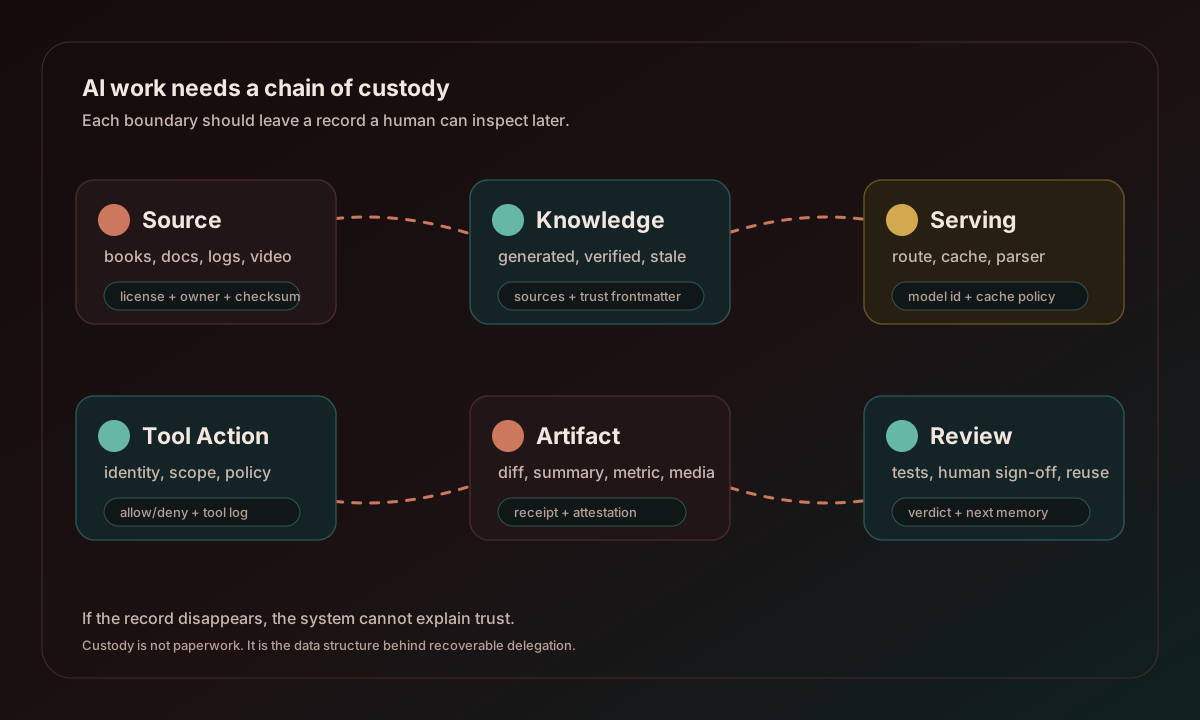
A useful agent system needs custody records across sources, generated knowledge, serving, tool calls, credentials, artifacts, and review.
Books Turn Data Provenance Into a Product Issue
The book-scanning story made the data problem concrete. Reports described AI data buyers acquiring old and out-of-print books, cutting bindings, scanning pages, and discarding originals. The legal debate will take its own path. The product lesson is narrower: clean data has a provenance cost.
Web data became polluted by generated text. Teams that need higher-signal corpora will chase sources with older custody chains: printed books, licensed archives, internal documents, verified databases, private code, meeting transcripts, and workflow logs. Each source needs answers before a model trains on it or an agent cites it:
| Custody question | Record needed |
|---|---|
| Who acquired the source? | Buyer, license, or owner record. |
| What was transformed? | Scan method, OCR output, page range, and loss record. |
| What survived? | Original location, copy quality, checksum, and retention policy. |
| Who may use it? | License terms, jurisdiction, consent, and allowed model use. |
| Which output used it? | Dataset version, retrieval citation, or training run link. |
That table applies outside books. A company wiki, a design system, a finance definition, and a support transcript all need the same shape of custody once agents read and rewrite them.
The Bun Rust rewrite audit raised a second custody issue: cost and labor. One observer challenged the public narrative around an AI-assisted rewrite by looking at release tags, pull requests, CI work, API cost, and human involvement. You do not need to accept every inference to see the value of the method. Claims about AI labor need receipts that include model spend, CI spend, human review, failed attempts, release status, and maintenance debt.
If a team says "the agent did the rewrite," the custody record should show:
- which agent produced which pull requests
- which humans reviewed them
- which tests and CI jobs ran
- which costs sat outside model tokens
- which release carried the work
- which defects arrived after merge
AI cost claims without custody records collapse into marketing.
Trust Metadata Belongs Next to Knowledge
Google's OKF v0.2 is the cleanest format-level signal from the day.
OKF treats agent-readable knowledge as markdown with YAML frontmatter. The v0.2 addition gives each concept frontmatter fields for provenance, trust, freshness, lifecycle, and attestation. The important move: an agent can decide whether to read or use a concept before it spends tokens on the body.
That gives you filters such as:
generated:
  by: reference_agent/gemini-2.5-pro
  at: 2026-06-30T14:00:00Z
verified:
  - by: human:finance-owner@example.com
    at: 2026-07-01T09:00:00Z
status: stable
stale_after: 2026-12-31
sources:
  - id: revenue-policy
    resource: policies/revenue-recognition.md
The format names the custody gap. Once agents generate thousands of facts, tables, metrics, runbooks, and definitions, another agent needs to know which concepts came from a trusted source, which concepts a human verified, which ones expired, and which computations ran through a sanctioned path.
Attested computation gives the format teeth. A knowledge bundle can define the computation, the executor, and the receipt fields. A deterministic attester can inspect the receipt and reject a value if the agent improvised SQL, changed a table, or displayed a number that does not match the run.
That pattern should spread.
| Agent output | Custody field to add |
|---|---|
| Finance metric | Source policy, approved SQL, job id, attester verdict. |
| Customer-support answer | Source article version, retrieval span, escalation policy. |
| Design change | Design token version, lint result, screenshot, reviewer. |
| Code patch | Issue, diff, tool log, tests, review status. |
| Meeting summary | Consent, speaker segments, transcript confidence, retention. |
Knowledge formats should make trust cheap to check.
Large Models Push Custody Into Serving
Kimi K3 on vLLM looked like a model-serving story at first: a 2.8T-parameter multimodal Mixture-of-Experts model, 1M-token context, Kimi Delta Attention, Attention Residuals, DSpark speculative decoding, hybrid prefix caching, tool calling, structured outputs, NVIDIA and AMD launch paths, and 370 tokens per second per user on a 16 GPU GB300 setup in vLLM's benchmark.
The agent lesson sits in the cache.
Long-context agents replay prompts, tool specs, repo snapshots, conversation state, and work logs. Serving engines now decide which prefixes deserve cache retention, which recurrent states survive, which prompt boundaries get checkpoints, and which shared prefixes get promoted after repeat hits. Those decisions affect cost, latency, privacy, and answer behavior.
That makes serving a custody layer.
| Serving decision | Why the user needs a record |
|---|---|
| Model route | Determines capability, provider exposure, and cost. |
| Prefix cache hit | Determines which prior context shaped the response. |
| Retention policy | Determines what gets reused and for how long. |
| Tool parser | Determines whether an action payload passed schema checks. |
| Structured output constraint | Determines whether the model could leave the contract. |
| Fallback route | Determines whether a weaker or different model handled the task. |
vLLM's Kimi K3 notes also contain a useful caveat for agent builders: tool calling must be validated on your own traffic. The serving layer can expose a tool parser, but production agents still need schema checks, retries, and fallbacks when tool calls parse empty or malformed.
Large models no longer sit behind a stateless /chat endpoint. The serving engine now participates in memory, policy, and audit.
Security Agents Need Proof, Scope, and Identity
NVIDIA's Open Secure AI Alliance announcement argued for open models, open harnesses, and shared security tooling. The useful part was the agent-stack framing: safety and security depend on identity, permissions, harnesses, guardrails, logs, evaluation, and model weights together.
That matched the better security projects in this group.
Strix, for example, pitches autonomous AI penetration-testing agents that run code, validate vulnerabilities, produce proof-of-concept exploits, and generate remediation guidance. That category has real value if the system keeps tight scope. A security agent should record target authorization, sandbox limits, exploit steps, proof artifacts, data touched, fix diff, and reviewer sign-off.
Open Code Review makes a similar point from the code-review side. Its stronger claim is not "LLM reviews code." Its stronger claim is that deterministic file selection, rule matching, bundling, positioning, and reflection constrain the model. The agent works inside a review process.
The security pattern is simple:
authorize scope
  -> run bounded agent
  -> capture proof
  -> patch or escalate
  -> preserve evidence
  -> review before promotion
Agent security tools should make the proof boring. That includes the proof that the agent stayed inside the scope.
Projects Worth Time
The useful projects fell into custody categories. Some help you preserve evidence. Some help you package behavior. Some create new risk at the credential layer.
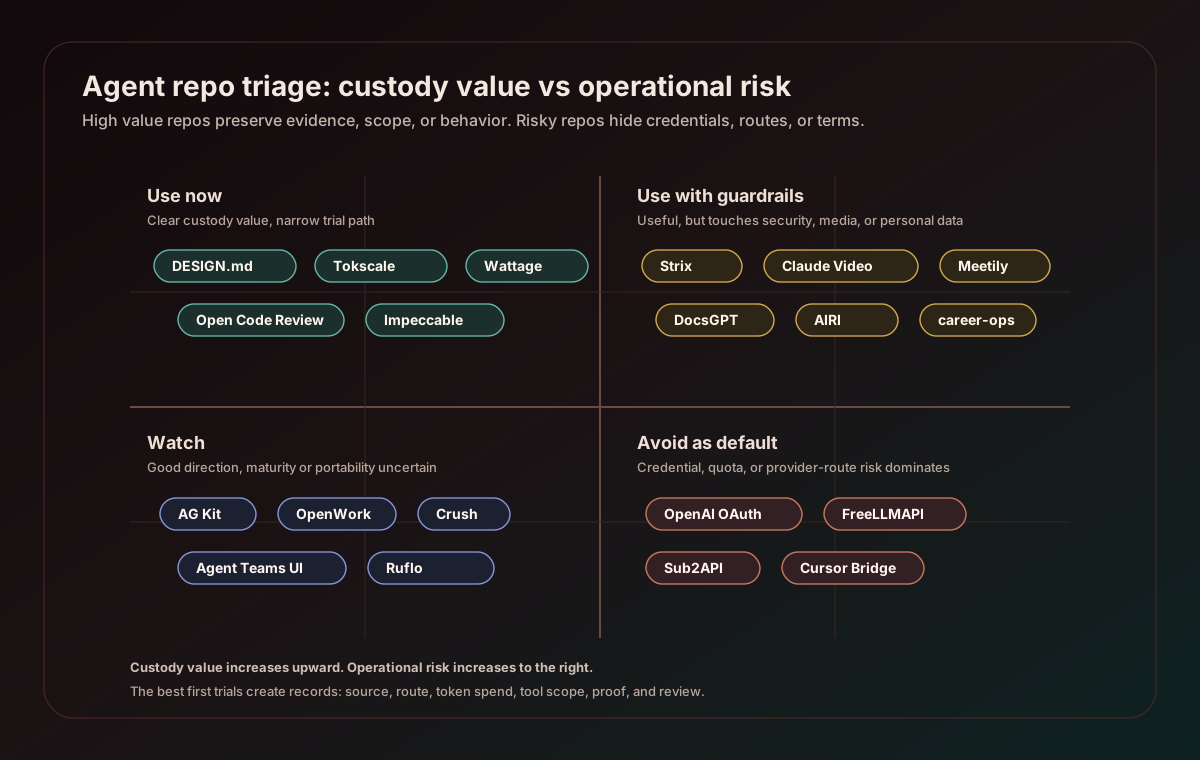
My triage after opening repos and reading docs. High value means the project attacks a real bottleneck. A production workflow still needs a local trial.
| Project | Value | Caveat |
|---|---|---|
| DESIGN.md | Turns visual identity into tokens plus rationale that agents can read, lint, diff, and export. This gives design work a versioned custody file. | A file format cannot create taste. Teams still need product direction and visual review. |
| Impeccable | Packages design guidance, commands, and deterministic detectors for agent-built frontends. It gives design review a harness. | Treat detector output as evidence before final approval. |
| Tokscale | Reads local session stores across coding agents and gives teams a token ledger. This turns spend into a traceable work artifact. | The tool reads sensitive local agent data. Review retention and sharing defaults. |
| Wattage | Profiles token spend from traces and can fail CI on cost regressions. It moves budget review closer to the change. | It needs real trace coverage and up-to-date pricing. |
| Strix | Agentic pentesting with exploit validation points at a real security workflow. | Run inside explicit scope. A tool that proves exploits needs strong boundaries. |
| Open Code Review | Hybrid deterministic plus LLM review is the right shape for line-level feedback. | Validate precision and recall on your codebase before replacing review rituals. |
Claude Video /watch | Video becomes a first-class agent input: captions, frames, timestamps, and focused questions. | Video carries privacy, copyright, and consent risk. Keep frame and transcript receipts. |
| last30days-skill | A research skill that joins social, video, forum, market, and web sources can produce useful recency briefs. | Engagement is not truth. Treat source scoring and auth cookies as custody issues. |
| AG Kit | Project-level rules, skills, memory, MCP guidance, validation hooks, and content inventories show a mature workspace-contract direction. | It binds to Antigravity as the production runtime. Portability needs testing. |
| OpenWork | Shared MCP capabilities, skills, plugins, and org access controls show where agent workspaces are headed. | Remote capability execution needs audit logs and least-privilege access. |
| Crush | Terminal coding agent with multi-model, session, LSP, and MCP support. Strong developer-surface signal. | Session custody matters once multiple providers and local tools enter one shell. |
| DocsGPT | Enterprise search plus agents, tool connections, SSO, RBAC, logs, and BYOM fit the private-knowledge custody problem. | Connector quality and permission mapping decide whether it is safe. |
| AIRI | Local companion and voice/game surfaces show embodied agents moving beyond chat. | Personal context, voice, and identity need stricter consent and deletion controls. |
| career-ops | Structured local job-search workflow with human-in-the-loop gates. It treats agent output as a draft and tracking system. | It touches sensitive personal data. Store less than the workflow tempts you to store. |
| Agent-teams dashboards | Kanban, logs, costs, providers, and multi-agent teams match the future work surface. | More agents multiply review load. Avoid "AI company" theater without ownership records. |
The weaker category was also clear: credential and quota gateways.
OpenAI OAuth, FreeLLMAPI, Sub2API, Cursor Bridge, and similar projects all respond to a real pressure: AI usage costs too much, providers fragment access, and developers want one endpoint. The risk sits in the solution. If a project turns a personal subscription, OAuth session, free tier, relay account, or pooled provider key into an API surface, the custody problem becomes sharp.
Ask these questions before using one:
| Gateway question | Required answer |
|---|---|
| Which account owns the request? | Per-user identity, not a shared mystery token. |
| Which provider saw the data? | Provider log for each request. |
| Which terms apply? | Explicit policy review and allowed use. |
| Which credentials persist? | Storage path, encryption, rotation, and revocation. |
| Which model answered? | Model id, fallback route, and response metadata. |
| Which data may cross the gateway? | Classification rules and redaction. |
Cheap token routes can erase custody.
Skills Package Behavior
The skill repos were more interesting than their marketing copy.
DESIGN.md, Impeccable, Marketing Skills, last30days, career-ops, AG Kit, and follow-builders all treat instructions as artifacts that agents can install, route, edit, and reuse. That makes skills a distribution format for behavior.
A skill can encode:
- design taste
- research sources
- marketing process
- job-search rubric
- video analysis workflow
- security guardrails
- memory rules
- tool permissions
That power needs the same custody records as code:
| Skill artifact | Record needed |
|---|---|
| Source material | License, author, date, and allowed reuse. |
| Generated instruction | Generator, reviewer, diff, and test prompt. |
| Selection event | Why the agent loaded the skill. |
| Tool access | Which commands, files, browsers, and accounts it can touch. |
| Behavior update | Version, changelog, rollback path. |
| Evaluation | Before/after tasks and failure cases. |
Skill libraries will break down if teams treat markdown instructions as harmless notes. A skill changes behavior. Behavior needs ownership.
Video and Voice Need Stronger Receipts Than Text
Claude Video, Meetily, DocsGPT speech workflows, and AIRI all point toward the same input shift. Agents are learning to watch, listen, transcribe, summarize, and act from richer context.
That creates better products. A bug report video can show the frame where a UI breaks. A meeting transcript can preserve the decision and owner. A companion app can keep a long-lived personal context.
The custody bar rises with media:
| Media input | Extra receipt |
|---|---|
| Screen recording | Frame timestamps, cropped regions, and redaction record. |
| Meeting audio | Consent, speaker labels, transcript confidence, retention. |
| Video URL | Download scope, captions source, frame budget, copyright status. |
| Voice agent | Wake state, command boundary, synthetic output marker. |
| Personal companion | Memory owner, deletion path, export path, and model route. |
Text agents can already leak secrets. Media agents can leak rooms, faces, voices, screens, and habits.
Validation Harness
A custody trial should leave machine-readable evidence for source, model route, credentials, tool authority, cache, artifact, review, and reuse.
okf lint knowledge/revenue.md --require generated,verified,sources,status,stale_after
tokscale export --since 7d --group-by task,model,retry --out out/token-ledger.json
wattage price traces/*.otlp --out out/cost-regressions.html
designlint check DESIGN.md --screenshots out/screenshots --out out/design-receipt.json
strix run --scope fixtures/scoped-target.yaml --evidence out/strix-proof --no-network-widening
gateway-audit inspect oneapi.log --require provider,account,model,credential_id
The report should look like a custody manifest:
{
  "source": {"id": "revenue-policy", "verified_by": "finance-owner", "stale_after": "2026-12-31"},
  "route": {"model": "kimi-k3", "provider": "self-hosted-vllm", "cache_hit": true},
  "tool": {"name": "security-scan", "scope": "fixtures/scoped-target.yaml"},
  "credential": {"gateway": "oneapi", "raw_secret_visible": false},
  "artifact": {"path": "out/design-receipt.json", "reviewer": "design-owner"},
  "reuse": {"allowed": false, "reason": "customer-derived input"}
}
The practical goal is recoverable delegation, with automation scoped by records.
Custody Contract
AI systems keep crossing custody boundaries:
- data becomes training material
- documents become agent knowledge
- prompts become long-lived cache entries
- credentials become gateways
- videos become evidence
- skills become behavior packages
- model routes become policy decisions
- tool calls become business actions
You can make that work if each boundary leaves a record.
The next useful layer in AI infrastructure is a custody log that a person can inspect under pressure:
Who supplied the source?
Who generated the knowledge?
Who verified it?
Which model and route ran?
Which credential allowed the action?
Which cache or memory shaped the answer?
Which tool changed the world?
Which test or reviewer accepted the result?
That is the difference between a demo and a system you can trust.
Sources
- Futurism: AI companies destroying rare books
- Tom Lockwood: How is the Bun rewrite in Rust going?
- Google Cloud: OKF v0.2 adds trust signals
- vLLM: Kimi K3 day-0 support
- NVIDIA: Open Secure AI Alliance
- GitHub: DESIGN.md
- GitHub: Impeccable
- GitHub: Tokscale
- GitHub: Wattage
- GitHub: Strix
- GitHub: Open Code Review
- GitHub: Claude Video
- GitHub: last30days-skill
- GitHub: AG Kit
- GitHub: OpenWork
- GitHub: Crush
- GitHub: DocsGPT
- GitHub: AIRI
- GitHub: career-ops
- GitHub: OpenAI OAuth
- GitHub: FreeLLMAPI
- GitHub: Sub2API