Control Planes for Local Agents
A field note on Muse Glimmer, Docker Sandboxes, CtxRay, agent skills, Harvey LAB, Qwen multimodal plugins, and why local agent work now needs hard boundaries around context, tools, data, and evaluation.
August 10 gave me a cleaner agent story than the usual model release week. A 30B local coding model arrived. Docker put more shape around disposable agent sandboxes. Skills repos grew into installable operating knowledge. A legal-agent benchmark made the eval surface less toy-like. A meeting-note leak showed what happens when AI products record private work without a hard data boundary.
I left with one read: local agents need a control plane.
The model can sit on your laptop. The agent can spawn tools. The skill pack can teach the agent cloud, UI, testing, or security workflow. None of that helps if the system cannot answer four small questions:
- what entered the model context
- which tool boundary allowed the action
- where the agent ran
- which eval or receipt proves the result
That is the useful product work now. The local agent stack needs walls, locks, receipts, and some boring self-checks before teams give it longer leash.
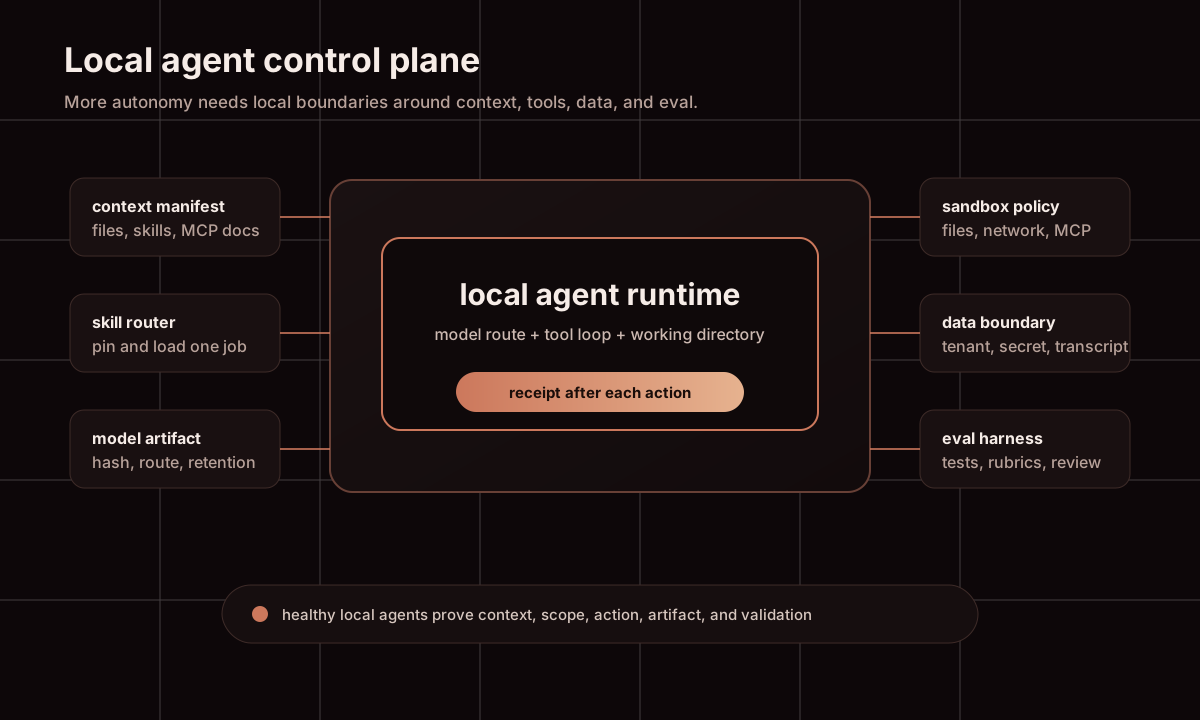
The useful layer is not one more agent persona. It is a local control plane around model, context, tools, sandbox, skills, data, and eval.
Local Model Is No Longer the Weird Path
Meta Muse Glimmer caught attention because it puts an open-weight 30B agentic model into the local-coding lane. Meta describes it as optimized for always-on local workflows on consumer hardware. Hugging Face exposes a normal model repository with a readable model card and a config.json route.
I did a small access check, not an inference benchmark:
curl -I https://huggingface.co/meta-models/Muse-Glimmer-30B/resolve/main/config.json
The request followed a 307 redirect and returned HTTP 200 with a 5,109 byte config. The README route also returned HTTP 200 with a 16,878 byte card. That is a small thing, but model delivery often fails on small things. A local model has to be pinnable, inspectable, and boring to fetch before it can become part of a work environment.
I did not run the 30B model on this laptop. That would be fake confidence. The machine can run Node, Python, uv, pnpm, git, and Docker CLI. A serious 30B local test needs GPU memory, quant choice, tokenizer sanity, and a repeatable coding task. The useful point for me is different: the model artifact now fits a product story where a coding agent does not need to send every file to a remote provider.
Local inference changes the boundary shape:
| Question | Remote model default | Local model default |
|---|---|---|
| Data exposure | Provider receives prompt and context. | User machine sees the prompt and weights. |
| Failure mode | Privacy, retention, routing, outage. | Hardware, install, memory, model freshness. |
| Control point | API key, policy, provider logs. | Artifact pin, local sandbox, tool receipts. |
| Good first test | Redaction and provider policy. | Config fetch, load time, memory, deterministic task. |
Local model does not make privacy true by itself. The agent can still read secrets, call tools, send output, and paste context into another service. Local model removes one network hop. The control plane still has to guard the rest.
Sandboxes Need Better First-Run Truth
Docker Sandboxes has the right product thesis: coding agents need disposable, isolated environments with file, network, credential, Docker Engine, and MCP boundaries. The docs expose policy pages for local access, network access, filesystem access, MCP access, credentials, and isolation layers. That is the language I want around agent execution.
My trial found the first-run problem fast.
docker context ls
returned two contexts:
default
desktop-linux *
The Docker CLI existed:
Docker version 27.3.1
Then the basic run failed:
docker run --rm hello-world
with:
open //./pipe/dockerDesktopLinuxEngine: The system cannot find the file specified.
sbx was not installed. winget search --name Docker.Sbx found no package on this Windows machine. That does not judge Docker Sandboxes as a product. It judges the setup path from my desk: the boundary product still depends on a healthy local Docker Desktop and a clear install route.
That first-run truth belongs in the product. An agent sandbox should have one command that says:
| Check | Good output |
|---|---|
| Engine | Docker Desktop engine reachable. |
| Sandbox CLI | Installed, versioned, account state clear. |
| Workspace | Mounted path, write policy, ignored secrets. |
| Network | Default deny or approved hosts. |
| MCP | Allowed tools and blocked tools. |
| Credentials | Which secrets can enter the sandbox. |
| Cleanup | Session deleted or preserved with reason. |
The product direction is strong. The local process still needs less mystery. If an agent can run unattended, the user should not have to debug pipes, CLI names, and policy files by smell.
My Trial Bench
I kept the trial bench plain: no paid calls, no private accounts, no secret-heavy integrations. I ran commands that a developer can run before trusting an agent product.
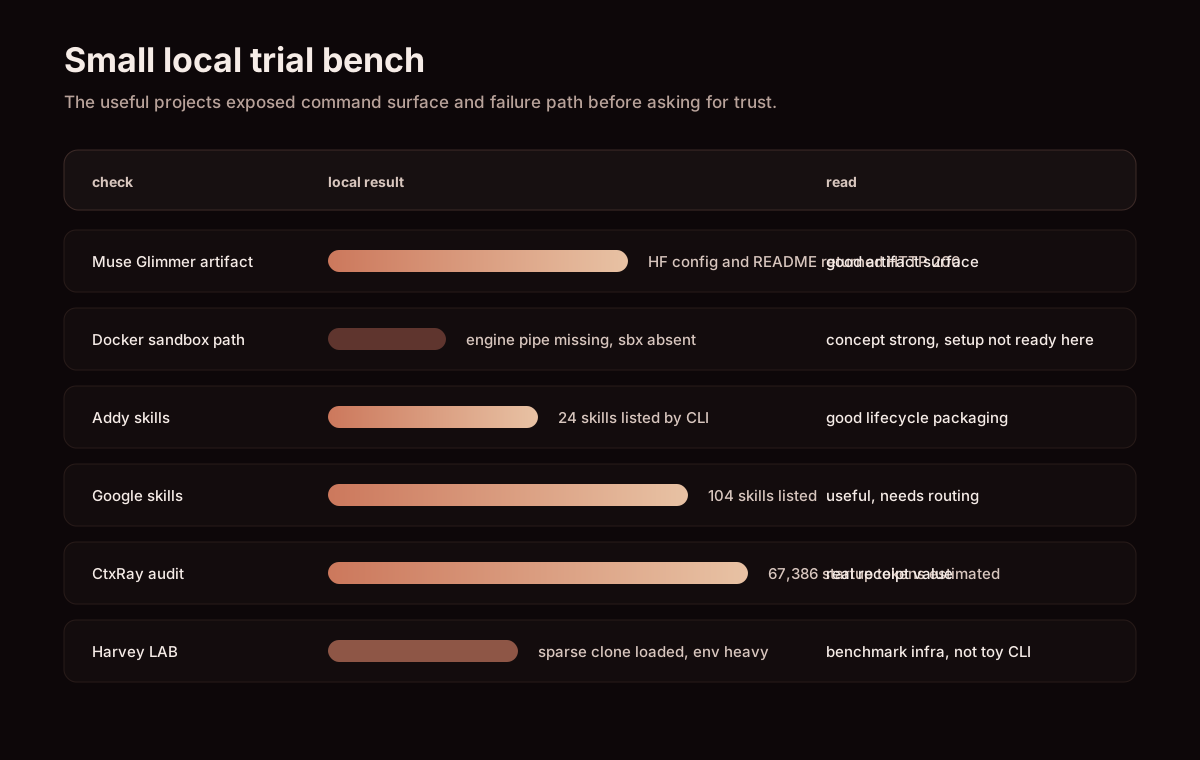
The best projects gave me a visible command surface. The weaker ones looked useful, but asked me to trust a big README before I could measure the boundary.
| Item | Command or check | Result | My read |
|---|---|---|---|
| Muse Glimmer | curl -I against HF config and README | HTTP 200 after redirect. Config and model card visible. | Good artifact surface. I still need a GPU run before judging coding quality. |
| Docker Sandboxes | docker context ls, docker run hello-world, sbx --version, winget search | Docker CLI present, engine unreachable, sbx absent, no winget hit. | Strong concept. First-run diagnostics should be a product feature. |
| Addy agent-skills | npx --yes skills add addyosmani/agent-skills --list | CLI found 24 skills. | Good packaging. The skill list matches software lifecycle work. |
| Google skills | npx --yes skills add google/skills --list | CLI found 104 skills. Many map to Agent Platform, GKE, BigQuery, and Google Cloud ops. | Useful for cloud-heavy teams. Also a context bloat risk. |
| CtxRay | npx --yes @framy2/ctxray doctor and audit | Doctor passed Node, Codex, price catalog. Audit estimated 67,386 startup tokens, 584 skills, 11 plugins, 3 MCP servers. | This is the kind of receipt local agents need. It made my own setup look messy. |
| Harvey LAB | sparse clone plus pyproject.toml inspection | Project metadata loaded. Full dependency env wanted heavy document, provider, plotting, and test packages. | Good benchmark shape. It is not a tiny install, and that is reasonable for legal work. |
| Agency Agents | shallow clone and catalog count | 316 markdown agent files across many divisions, with 58 in engineering and 57 specialized. | Big persona catalog. Useful as reference, risky as default context. |
| Qwen-MM-Plugins | README and install docs | Capability split into skill plus optional MCP server. Core, video-memory, omni-av, video-edit, Blender, FreeCAD, edu-agent. | Strong architecture. Native Windows is not validated; WSL2 is the path. |
| Ante | README and release docs | Single Rust binary claim, macOS/Linux focus, Windows via WSL, offline GGUF path. | Worth watching. I did not run it on native Windows. |
The pattern is clear. The best tools expose nouns the operator can understand: profile, lock, drift, receipt, sandbox, policy, skill, eval, artifact. The weaker pitch says "install these 300 agents" and expects the user to sort out context, ownership, and scope later.
Skills Are Becoming Configuration
Agent skills now behave like configuration.
Addy Osmani's agent-skills repo maps skills to a software lifecycle: spec, plan, build, test, review, web performance, simplification, and ship. The skills CLI could list 24 skills without installing them. That is a good sign. Browse before install should be normal.
Google's skills repo is much bigger. The same CLI listed 104 skills. The most useful parts for agent work sit in Agent Platform, GKE inference, BigQuery AI and ML, prompt management, RAG, alerting, troubleshooting, and Google Cloud production hardening. A cloud team could save time by loading one exact skill instead of pasting 20 pages of docs into a chat.
The danger comes from the same strength. A skill repo can turn into a private doctrine dump. My CtxRay audit saw 584 available skills in my Codex environment and estimated about 67,386 known startup tokens. It also warned about duplicate skill names and unreadable plugin cache entries. I did not expect a tiny portfolio repo session to have that much context surface.
That made the point better than any diagram. A local agent needs skill governance:
| Skill control | Reason |
|---|---|
| Browse before install | The user sees scope before context enters. |
| One skill per task phase | The agent does not load every wisdom file. |
| Versioned lockfile | A teammate can reproduce the capability surface. |
| Drift check | CI can fail when hidden context changed. |
| Per-skill source link | Reviewers can inspect where behavior came from. |
| Token budget | A skill pack should not tax every turn. |
Qwen-MM-Plugins shows the more advanced version. It splits capability into a skill plus an optional MCP server. The skill tells the model the tool exists. The MCP server does work. That split is right. A model should not gain file, video, OCR, Blender, FreeCAD, or web-search authority because somebody pasted a long instruction into the prompt. The tool boundary needs its own config.
I would treat skill installation like dependency installation. Pin it. Review it. Load the smallest useful part. Remove it when the job ends. A team that would never run a random npm postinstall should not load a random agent skill with full trust.
Persona Catalogs Need Friction
Agency Agents has a huge catalog: my shallow clone counted 316 markdown files. Engineering alone had 58 files. Specialized had 57. Marketing had 36. The app and scripts target Claude Code, Cursor, Codex, Gemini CLI, OpenCode, Qwen, and other tools.
I understand why people like this. It gives names to modes: frontend developer, security reviewer, product strategist, tester, marketer. A new user can ask for a role and get a shaped workflow.
I would not install the whole catalog into my default agent setup.
The value sits in the best files as inspectable templates. The risk sits in mass activation. A persona file can carry style, process, success metrics, hidden assumptions, and tool expectations. Scale that by 316, then add project AGENTS files, MCP tool docs, system instructions, plugins, and memory. You get a soup, not a team.
Personas should pass the same boundary test as skills:
| Question | Minimum answer |
|---|---|
| Who owns this persona? | Maintainer, source, version. |
| Which task should load it? | One job, not whole session. |
| What tools can it call? | Named tools and denied tools. |
| What output should it produce? | Artifact contract, not loose prose. |
| What should override it? | Project policy and human instruction. |
The catalog idea has use. The default behavior needs friction. Install one agent because the job needs it. Keep the rest on disk.
Legal Evals Point at Real Work
Harvey LAB impressed me more than most agent benchmark launches because it chooses a domain with documents, rubrics, practice areas, and task harnesses. The README says LAB contains tasks with agent instructions, documents, and rubrics plus an execution harness. The project badges list 24 legal practice areas and 1,671 tasks.
My sparse clone loaded the repo metadata and pyproject. The dependency list made sense for the domain:
pdfplumber
openpyxl
markitdown
python-docx
python-pptx
anthropic
openai
google-genai
mistralai
pandas
matplotlib
seaborn
pytest
That is not a toy stack. Legal agent eval means document extraction, office files, model adapters, scoring, reports, and visualization. My attempt to use uv run against the sparse clone ran long enough to hit the automation timeout while resolving the env. That is not a failure of LAB in my eyes. It tells me the benchmark should run as a deliberate project setup, not a casual npx stunt.
I like two things here.
First, the domain creates real constraints. A legal task has source documents, an expected work product, and rubrics. An agent cannot win by returning a nice paragraph. It must read, reason, and write within a practice frame.
Second, the benchmark makes harness design visible. Agent eval covers model selection, document tools, scratchpad policy, retry behavior, context packing, and judge strategy. Harvey's initial-results post talks about tradeoffs around model selection, harness optimization, and post-processing. That is the right level.
This kind of benchmark should connect to the local control plane. Each run should store:
task id
document ids
model route
context manifest
tool calls
generated artifact
rubric scores
judge prompt/version
human review notes
Without those records, legal-agent eval becomes a leaderboard with a serious suit. With those records, a team can debug why the agent missed a clause, overused a source, or invented a bad argument.
The Meeting Leak Is the Product Spec
The meeting-notetaker exposure made the rest of the week feel less abstract. The reported issue involved more than 181,000 AI meeting records left open through a Firebase rule mistake. Dark Reading reported that authenticated users could query other users' meeting information and join calls. The vendor sells AI recording, transcription, and summaries for Zoom, Google Meet, and Teams.
I do not care about the drama angle. I care about the product spec it writes for every AI app that touches private work.
An AI meeting product needs these controls before the nice summary screen:
| Boundary | Minimum behavior |
|---|---|
| Tenant data | A user can query records owned by their workspace. |
| Live meeting join | Join URLs need per-user authorization and expiry. |
| Recording state | Metadata cannot reveal private meetings across tenants. |
| Transcript access | Default deny, explicit share, auditable read path. |
| Bot identity | Meeting participants know the bot account and owner. |
| Retention | Workspace owner can set deletion and export policy. |
| Incident proof | Vendor can answer which meetings got exposed. |
AI makes this harsher. The app holds more than a file. It holds voices, names, decisions, internal plans, customer stories, and action items. A transcript is a compressed version of the room. If the access rule fails, the AI feature becomes a surveillance feature by accident.
That maps back to local agents. A coding agent records prompts, command outputs, diffs, screenshots, browser state, API responses, and sometimes secrets. A research agent records PDFs, notes, and synthesis. A video agent records voices and faces. The product should assume those traces are sensitive from day one.
The control plane needs data boundaries as much as model boundaries.
Repos That Passed My Value Filter
I used a plain filter: does this project reduce one concrete failure mode, and can I see the operating surface without trusting a marketing page?
| Project | Value | Caveat |
|---|---|---|
| Muse Glimmer | Pushes local agentic coding models into a normal artifact route. HF config and README paths worked. | I did not benchmark inference. Hardware and quant path decide real usefulness. |
| Docker Sandboxes | Names the right control surfaces: workspace, network, filesystem, MCP, credentials, isolation. | My Windows first-run path hit missing engine and absent sbx. Needs a crisp self-check. |
| CtxRay | Exposes context, profiles, locks, drift, quota, and receipts around Codex. My audit found real startup-context mess. | Young project. Benchmarks are bounded and author-run. |
| Addy agent-skills | Lifecycle skills install through a real CLI and list before install. | Skills can become hidden process if teams load them by habit. |
| Google skills | Deep cloud-operation skill catalog with Agent Platform and GKE coverage. | 104 skills need routing discipline, or context cost grows. |
| Harvey LAB | Domain benchmark with tasks, documents, rubrics, harness, and model adapters. | Heavy environment. Best treated as benchmark infra. |
| Qwen-MM-Plugins | Good split between skill knowledge and optional MCP tool servers for multimodal work. | Windows users go through WSL2. Some capability docs are still TBD. |
| Ante | Single Rust binary and offline GGUF path are attractive for local agent work. | macOS/Linux first. I did not run it on native Windows. |
| Agency Agents | Large reference catalog for role-shaped work. | Too many personas become context debt if installed wholesale. |
I cut several things from the main story. A shopping agent, a murder-mystery voice game, generic AI portals, and small redaction apps can be interesting, but they did not change my engineering view today. The durable signal came from boundaries and evidence.
A Small Control Plane I Would Ship
For a local coding-agent team, I would ship this before granting more autonomy:
- Context manifest. Record project instructions, skills, files read, snippets selected, MCP docs loaded, and omitted high-risk files.
- Skill router. Load one task skill at a time. Pin source and version. Keep a lockfile.
- Sandbox preflight. Check engine, CLI, account, workspace mount, network policy, filesystem policy, MCP policy, credentials, and cleanup.
- Model route record. Store provider, local artifact hash or remote model id, context window, retention setting, and cost class.
- Tool receipts. Save command, cwd, redacted env, network target, exit code, artifact path, and diff summary.
- Data boundary. Classify transcripts, screenshots, browser state, documents, and secrets before they enter prompts or logs.
- Eval harness. Use task-specific checks. For legal, use rubrics and document ids. For code, use tests, typecheck, lint, screenshots, and review.
- Drift check. Fail CI or warn the user when skills, plugins, MCP tools, or policy changed since the last trusted run.
This is not giant platform engineering. A team can start with JSON files, a .agent-lock.json, and CI artifacts. The point is to make the local agent legible. A person should know what the agent knew, where it acted, and why the system allowed it.
Close
The agent stack is moving back onto the user's machine: local models, local sandboxes, local skills, local multimodal plugins, local receipts. That is good. It also moves responsibility back to the user's machine.
A bigger model can write code. A bigger persona catalog can sound confident. A bigger skill repo can carry more process. The system earns trust when it proves boundaries:
context is known
skills are pinned
tools are scoped
sandbox is healthy
data access is tenant-safe
evals are tied to real work
receipts survive the session
That is where I would spend engineering time. Local agents need a control plane before they need another clever agent name.
Sources
- Meta Research: Introducing Muse Glimmer
- Hugging Face: meta-models/Muse-Glimmer-30B
- Docker: Docker Sandboxes
- Docker Docs: Sandboxes
- Docker Docs: Isolation layers
- BobDaHacker: tl;dv hack writeup
- Dark Reading: AI notetaker exposes government, corporate video calls
- GitHub: addyosmani/agent-skills
- GitHub: google/skills
- GitHub: FramY2/ctxray
- GitHub: harveyai/harvey-labs
- Harvey: Introducing Harvey's Legal Agent Benchmark
- Harvey: Legal Agent Benchmark initial results
- GitHub: QwenLM/Qwen-MM-Plugins
- GitHub: AntigmaLabs/ante
- GitHub: msitarzewski/agency-agents